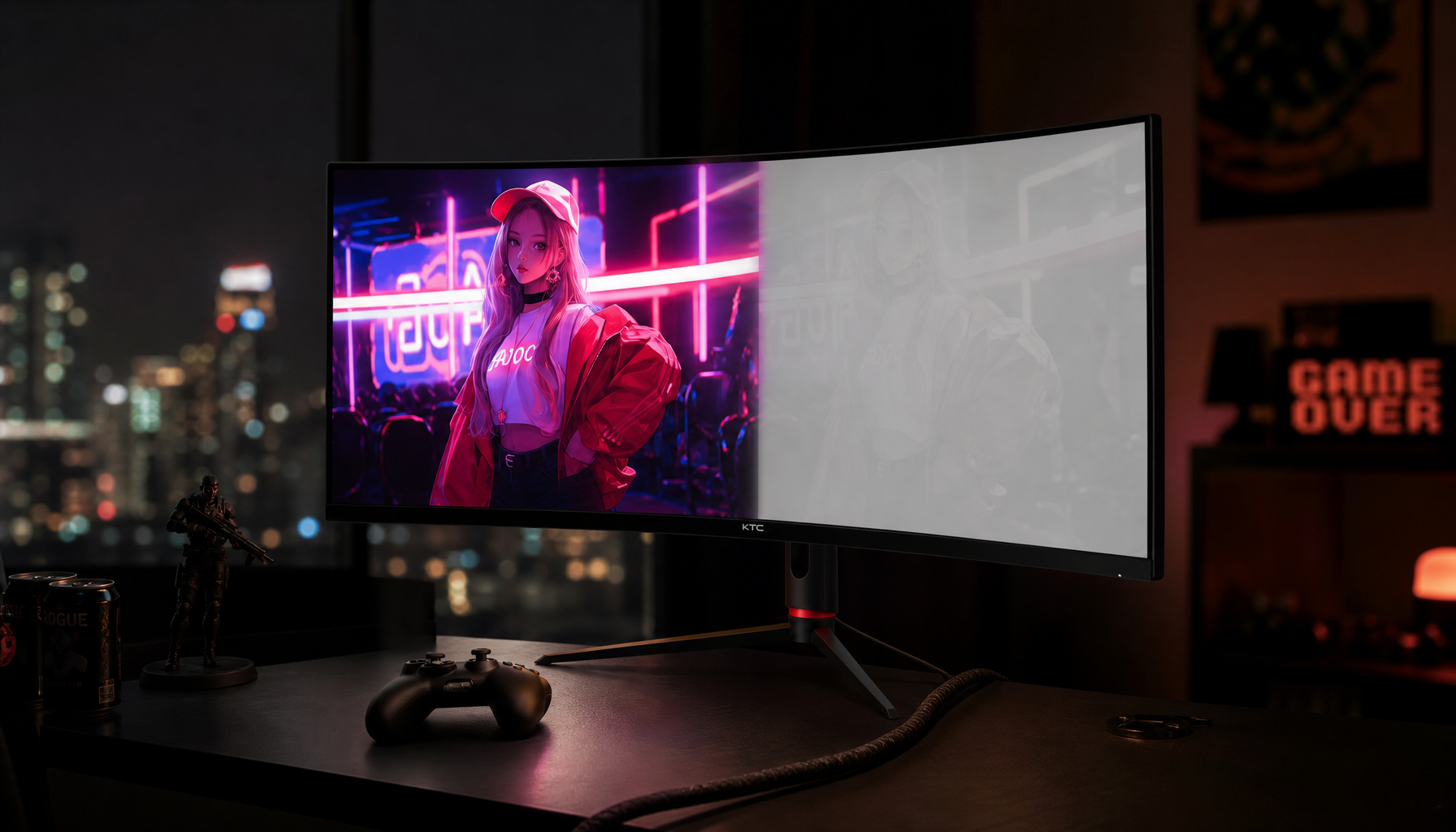
Aggressive dimming can make blacks deeper and highlights punchier, but it can also hide the fine dark information that makes games, photos, and movies readable.
Ever lose an enemy in a dark hallway because your monitor made the scene look cinematic but unreadable? In real setup work, the fix is testable: balance dimming against gamma, contrast, room light, and real dark-scene content instead of trusting one dramatic preset. Here is how to get stronger immersion without crushing the details your display is meant to show.

The Core Trade-Off: Deeper Blacks vs. Visible Near-Blacks
Aggressive dimming reduces light output in dark areas, either globally across the whole screen or locally through zones on a mini-LED or full-array backlight. The benefit is clear: blacks look darker, bright objects stand out more, and perceived contrast improves. For gaming monitors and media displays, that can make space scenes, night maps, horror games, and HDR movies feel more dimensional.
The cost is shadow detail: the visible texture, shape, and separation inside very dark parts of an image. A black jacket should not become a flat silhouette if the fabric folds are encoded in the content. A dark doorway in a tactical shooter should look dark, but not like a pasted black rectangle. Display contrast is the gap between peak white and deepest black, and a higher static contrast ratio generally improves image separation, but contrast ratio alone does not guarantee that every near-black step remains visible.

The practical tension is this: aggressive dimming improves black depth by lowering light, while shadow detail preservation requires enough separation between dark gray steps. If the dimming system or brightness setting pushes RGB 18, 22, and 28 into the same visible black, the image may look rich at first glance and weak in actual use.
Why Aggressive Dimming Looks Good at First
A display with stronger black levels often feels more expensive because the image gains depth. In a dim room, a VA gaming monitor with stronger native contrast can look more cinematic than a typical IPS office monitor. A mini-LED monitor can go further by controlling groups of backlight zones, which lets bright UI, explosions, or HDR highlights coexist with darker parts of the image.
That is why local dimming matters. Instead of lowering the entire backlight, it dims specific regions of the screen. This can improve HDR impact, especially in mixed scenes with bright highlights and dark backgrounds. The same principle explains why static contrast is usually more useful than inflated dynamic contrast claims: static contrast reflects bright and dark elements in the same image, while dynamic contrast may change the backlight between scenes.
For example, imagine a 300-nit display. If its black level is 0.3 nits, the contrast ratio is 1,000:1. If the black level falls to 0.1 nits at the same brightness, contrast rises to 3,000:1. That improvement is visible in a dark room. The risk is that a dimming algorithm may lower the dark zone so far that near-black texture disappears with it.
Where Shadow Detail Gets Lost
Shadow detail usually fails in three places: the panel’s native black handling, the dimming algorithm, and the user’s brightness or gamma settings. The most common result is black crush, where separate dark tones collapse into one undifferentiated black.
Monitor brightness and contrast controls are not universal. A “40 brightness” setting on one model may behave nothing like “40” on another. Community calibration advice around monitor setup often points users toward test patterns because brightness controls black levels, while contrast controls the upper end of the image. Lowering brightness too far may make blacks deeper, but it can also erase dark grays.
Gamma is just as important. A higher gamma target, such as 2.4, can make an image look deeper in a dark room, but it may also make low-end tones harder to see if the room is brighter or the display’s near-black tracking is poor. In home theater calibration discussions, users often find that a technically acceptable test-pattern result still disappoints in real dark scenes. One case described a calibrated plasma profile with accurate color and grayscale, yet the owner preferred other settings because dark-scene detail was too hard to see.
Aggressive Dimming vs. Shadow Detail: Practical Comparison
Setting Behavior |
What You Gain |
What You Risk |
Best Use Case |
Strong global dimming |
Deeper full-screen blacks and lower eye strain in dark scenes |
Whole image may become too dim, with hidden UI or lost dark texture |
Movie watching in a controlled dark room |
Strong local dimming |
Better HDR pop and stronger perceived contrast |
Blooming, pumping, or crushed near-black detail around bright objects |
HDR gaming and cinematic content |
Moderate dimming |
More stable dark detail with still-improved contrast |
Blacks may look less dramatic |
Competitive gaming, productivity, mixed desktop use |
Dimming off or low |
Most predictable tonal visibility |
Washed-out blacks on LCD panels |
Photo editing, SDR desktop work, shadow checks |
How to Choose the Right Balance for Gaming
For competitive gaming, shadow visibility usually beats maximum black depth. If a dark corner hides motion, you are losing useful information. This does not mean you should wash out the screen. It means you should avoid the local dimming or black equalizer setting that makes the image impressive in a trailer and unreliable in a match.
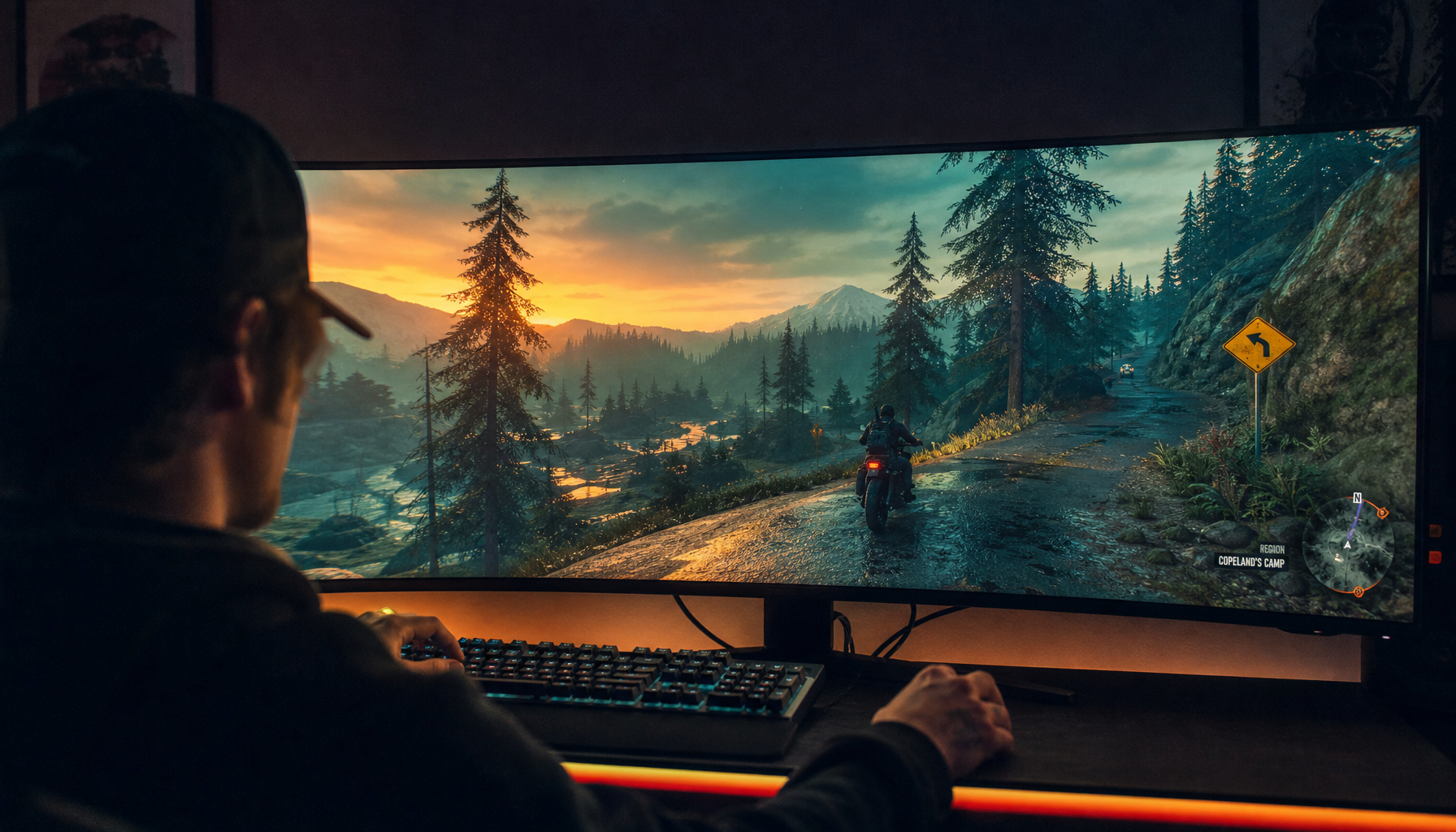
Use a dark game you know well, not only a test image. Stand in a night scene with dark walls, dark clothing, and a bright HUD. If the HUD causes nearby shadows to pulse, your local dimming is too aggressive for that title. If enemies blend into doorways unless you raise in-game brightness far above the default, the monitor’s black level or gamma behavior is probably too heavy.

HDR adds another layer. HDR quality is not only peak brightness. A display discussion makes a useful point: HDR can benefit from brightness range, contrast, and wide color gamut, and some users still enjoy HDR gaming on roughly 300-nit displays when the game implementation is strong. That matters because HDR gaming can look better through correct tone mapping than through raw brightness alone.
For most players, the reliable setup is moderate local dimming for immersive single-player games and reduced or disabled local dimming for competitive titles where dark-scene readability matters. If your monitor has separate presets, build one for HDR media and one for esports instead of forcing one profile to do everything.
How to Choose the Right Balance for Office and Creative Work
For office work, aggressive dimming can be more distracting than helpful. Large white documents, dark sidebars, code editors, browser tabs, and video windows create mixed-content screens that may trigger visible brightness shifts. If the monitor dims based on content, a spreadsheet can feel stable one moment and dull the next.

For creative work, consistency is the priority. Auto brightness, content-based dimming, and sensor-driven changes can break trust in what you are seeing. Operating systems may include ambient-light adjustment and content-adaptive brightness, and users often disable these features when consistent brightness matters because auto brightness can interfere with color accuracy and calibration.
The same idea appears in print workflows. Shadow tones can look separated on-screen but merge in print because the dark end of the tone curve compresses detail. The right response is not simply to make the image brighter, but to use curves to move important dark tones into a range where separation is stronger. For display setup, the parallel is straightforward: preserve black and white points, but make sure near-black tones are not being crushed by the monitor mode.
A Practical Calibration Workflow
Start with the monitor’s standard, sRGB, creator, or cinema preset, whichever is least processed and closest to neutral. Avoid starting from vivid, dynamic, or game-enhancer modes because they often stack contrast expansion, sharpening, and dimming behavior at the same time.
Next, set brightness for the room. In a bright office, higher brightness helps overcome glare. In a dark room, lower brightness is more comfortable, but do not lower it until the first few dark gray test bars vanish. Use a black-level test pattern, then verify with real content. A test pattern can show whether the monitor separates near-black steps, while a dark game or film scene shows whether the dimming algorithm behaves under motion and mixed highlights.
Then adjust local dimming strength. On mini-LED monitors, high local dimming may be best for HDR movies and visually rich single-player games. Medium is often the better everyday compromise. Low or off is usually more stable for desktop work, photo editing, and games with persistent HUDs.
Finally, check the graphics driver and operating system. GPU control panels can alter gamma, brightness, contrast, and color output before the signal reaches the monitor. If the display suddenly looks too dark or washed out, reset driver color settings before assuming the monitor failed.
Pros and Cons of Aggressive Dimming
- Pro: Stronger perceived contrast and richer blacks.
- Pro: Better HDR impact in controlled lighting.
- Pro: More immersive dark scenes on LCD-based HDR monitors.
- Con: Possible black crush, blooming, and delayed brightness shifts.
- Con: Less stable brightness during desktop and productivity work.
What Should You Prioritize When Buying?
If you play atmospheric games, watch HDR movies, or work in a dim room, prioritize stronger native contrast and well-reviewed local dimming. VA, OLED, and mini-LED displays each approach the problem differently. VA often gives strong static contrast for the money. OLED gives pixel-level black control but comes with price, brightness, burn-in management, and text-rendering considerations. Mini-LED can deliver high brightness and deep blacks, but zone count and algorithm quality matter.
If you mostly code, write, browse, or edit photos, prioritize consistency. A 1,000:1 static contrast display can be perfectly practical for office work if brightness is stable and color behavior is predictable. For immersive gaming and media, around 3,000:1 or better static contrast is a more satisfying target when the room is dim and dark-scene depth matters.
Do not rely on dynamic contrast marketing. Look for measured static contrast, black level, local dimming behavior, HDR tone mapping, and whether reviewers mention black crush or blooming. If the monitor lets you control local dimming separately for SDR and HDR, that is a real usability advantage.
FAQ
Should I turn local dimming off for SDR desktop use?
Often, yes. SDR desktop content usually benefits from stable luminance more than maximum black depth. If white windows, dark apps, and browser tabs cause visible brightness shifts, lower local dimming or turn it off for work.
Is black crush always caused by the monitor?
No. It can come from monitor brightness, gamma, local dimming, GPU color settings, video range mismatch, game HDR calibration, or room lighting. That is why real-scene testing matters after pattern-based setup.
Does higher contrast always mean better shadow detail?
No. Higher contrast can help, but shadow detail depends on whether the display separates near-black tones clearly. A display can look very dark and still hide information if its gamma or dimming behavior is too aggressive.
The best display setup is not the darkest one. It is the one that gives you deep blacks, stable highlights, and readable near-black texture under the lighting and content you actually use. For performance-driven gaming and reliable daily work, treat dimming as a precision control, not a trophy setting.