Children and teenagers are more vulnerable to display-related eye concerns because their eyes are still developing, they often use screens at close range for long sessions, and reduced outdoor time can add to myopia risk.
Does your child finish homework or gaming with headaches, red eyes, or a sudden lack of interest in reading? In one survey of children using screens for online learning, 48.2% reported three or more digital eye strain symptoms, and average daily display use was just over 7 hours. This guide explains why young eyes react differently to monitors and how to choose and set up displays more carefully at home.
Why Young Eyes React Differently to Displays
Developing Vision Is Still Adapting
Children and teenagers are not simply smaller adults when it comes to monitor use. Their visual system is still developing, and long periods of near focus can place steady demand on accommodation, the eye’s focusing system. Screen-based behavior research describes display use as a public health concern because it combines near work, reduced outdoor activity, glare, and sedentary habits in ways that can affect children’s visual comfort and development screen-based behavior.
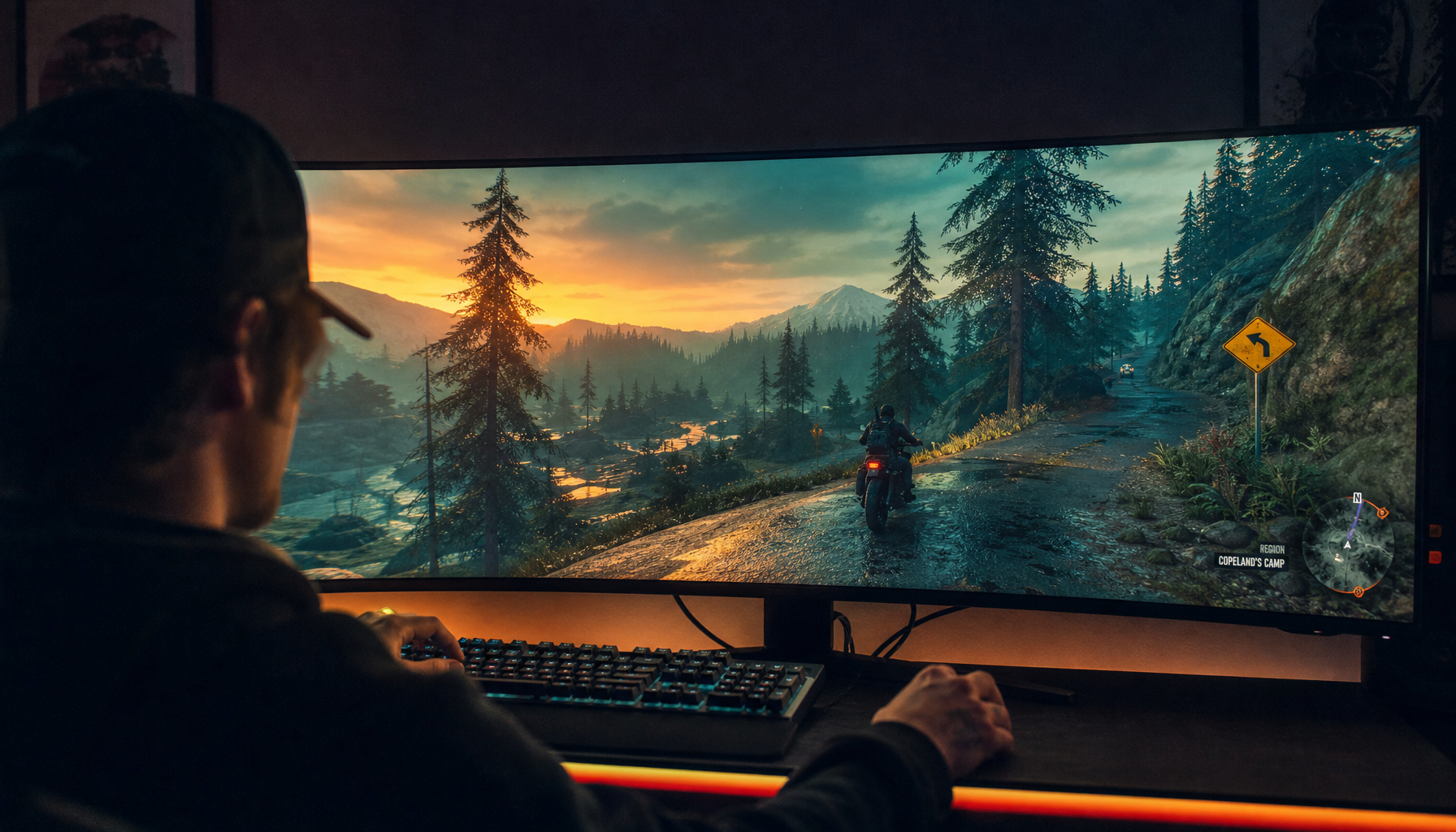
This matters most when a child’s day includes schoolwork on a laptop, homework on a desktop monitor, and gaming on a high-refresh-rate display in the evening. The problem is not that one monitor is automatically harmful. The concern is the total pattern: hours of close focus, few distance breaks, and limited daylight exposure.
Monitors Are Better Than Small Screens, But Setup Still Matters
A desktop monitor can be easier on young eyes than a cell phone because it supports a longer viewing distance, larger text, and better posture. But those benefits disappear if the screen is too close, too bright, too reflective, or positioned like an adult workstation for a much shorter child.
For a practical example, a 24-inch or 27-inch study monitor placed roughly arm’s length away is usually easier to manage than a tablet held near the face. A 27-inch 4K office display such as a 27-inch 4K IPS 60Hz low-blue-light home and office monitor still needs comfortable text scaling, moderate brightness, and regular breaks; resolution alone does not make a setup child-friendly. The monitor should not force the child to look upward, because looking up can worsen dryness by exposing more of the eye surface. A height-adjustable stand or monitor arm is often more important for a child’s setup than a premium panel feature.

The Main Risk Pattern: Near Work Plus Too Little Outdoor Time
Myopia Risk Is About the Whole Visual Day
Myopia, or nearsightedness, is not caused by one homework session or one gaming monitor. The stronger concern is repeated long-duration near work, especially when it replaces outdoor time. Pediatric vision sources connect rising myopia with too little time outdoors and too much close work, including screen time visual environment.

This is why monitor buying advice for families should not stop at resolution or refresh rate. A child who uses a 27-inch monitor at a reasonable distance, takes breaks, and spends time outside is in a different risk pattern from a child who sits close to a bright screen for several hours without looking across the room.
Age Changes the Level of Concern
Children under 10 deserve the most caution because they are in a key window for visual development. Screen exposure before age 3 has been associated with a higher likelihood of myopia by preschool age, and research summarized by a pediatric vision source reports that heavy screen users ages 6 to 7 were five times more likely to have myopia than light users heavy screen users.
Teenagers also need guardrails, especially because their monitor sessions can be longer and more intense. A teen may use a laptop for school, a second monitor for coding or video editing, and a 144 Hz or 240 Hz gaming monitor at night. The risk is less about the refresh rate itself and more about continuous near focus, short sleep, dry eyes, and lack of breaks.
Digital Eye Strain: What Parents Should Watch For
Symptoms Often Show Up as Behavior
Digital eye strain can include headaches, eye fatigue, burning, irritation, redness, blurred vision, dry eyes, and difficulty focusing. In a study of 692 children under 18 during online learning, 80.5% used a device for more than 30 minutes without a break, 62.1% used screens for more than 4 hours daily, and headaches were reported by 52.2% digital eye strain.

Parents may not hear “my eyes are strained.” They may see rubbing eyes, squinting at the monitor, leaning forward, losing interest in reading, complaining about headaches after gaming, or asking to enlarge text. Those signs are especially relevant if they appear after display use and improve after time away from screens.
Dryness and Focus Fatigue Are Common
Long monitor sessions reduce blinking, which can make eyes feel dry or irritated. A children’s hospital notes that children may report headaches, eye pain, tired eyes, or loss of interest in reading after prolonged screen focus, and it recommends a 20-20-20-2 pattern: every 20 minutes, look at least 20 ft away for 20 seconds, blink 20 times, and get 2 hours outdoors daily 20-20-20-2 pattern.

Temporary focusing trouble can also happen after a child stares at one fixed monitor distance for too long. If a child looks up from a gaming monitor and says distant objects look blurry for a while, that is a sign to shorten sessions, increase breaks, check viewing distance, and schedule an eye exam if symptoms repeat.
Monitor Features That Matter Most for Young Users
Comfort Features Beat Spec Sheet Hype
For children and teenagers, the best monitor is not always the fastest or biggest one. The most useful features are the ones that make healthy setup easier: height adjustment, tilt, low glare, stable brightness control, readable resolution, and enough screen size to keep text large at a comfortable distance. A professional optometric association notes that glare, reflections, lower contrast, viewing distance, and viewing angle can all increase digital visual demand computer vision syndrome.
High refresh rates can make motion look smoother in games, and many teens prefer 144 Hz or higher for competitive play. But refresh rate does not replace breaks, proper distance, or an eye-friendly setup. A 165 Hz gaming monitor used for 3 uninterrupted hours in a dark room can still leave a teenager with dry, tired eyes.
What to Prioritize When Buying
A 24-inch monitor is often a sensible choice for younger children because it allows comfortable text size without overwhelming a small desk. A 27-inch monitor can work well for older students and teens if the desk is deep enough. Ultrawide monitors can support multitasking, but they need enough viewing distance and careful brightness control across the full panel.
Portable monitors are useful for travel, tutoring, or small desks, but they are often placed too low and too close. If a child uses one regularly, pair it with a stand and external keyboard so the screen can sit farther away and closer to eye level.
Display Option |
Best Fit for Young Users |
Main Eye-Comfort Advantage |
Watch-Out |
Practical Setup Tip |
Elementary to middle school homework |
Easy to keep text readable without sitting close |
Cheap stands may lack height adjustment |
Use a riser or arm so the top of the screen is near eye level |
|
27-inch monitor |
Teens, schoolwork, creative projects, gaming |
More space for large text and split windows |
Needs a deeper desk |
Keep it about arm’s length away and avoid leaning forward |
High-refresh-rate gaming monitor |
Teen gamers |
Smoother motion may feel more comfortable during fast games |
Long sessions still cause strain |
Use built-in timers or game breaks every 20 minutes |
Ultrawide monitor |
Older teens multitasking |
Reduces window switching and supports large layouts |
Wide panels can encourage fixed staring |
Center the main task and avoid max brightness at night |
Portable monitor |
Travel, tutoring, small spaces |
Larger than a cell phone or tablet |
Often sits too low and too close |
Add a stand and external keyboard for better distance |
How to Set Up a Child or Teen Monitor Station
Distance, Height, and Text Size
Start with distance. A monitor should usually sit about arm’s length away, with text enlarged enough that the child does not lean forward. A child screen-use research organization describes screens as “near media” because children usually view them close to the eyes, and prolonged close viewing can keep the eyes fixed at one distance for hours near media.
Next, check height. The screen should not make the child tilt the head up. A slightly downward gaze is usually more comfortable than an upward one, especially for dry eye symptoms. If the desk was built for an adult, the fix may be simple: lower the chair, add a footrest, use a monitor arm, or switch to a smaller screen that fits the child’s seated posture.

Brightness, Glare, and Room Lighting
Set monitor brightness to match the room, not to the maximum setting. A bright gaming monitor in a dark bedroom creates contrast stress, while a dim screen in a sunny room can make a child squint. Use curtains, reposition the monitor away from direct window reflections, and avoid placing a glossy screen under overhead glare.
A medical center lists glare, poor lighting, poor posture, wrong viewing distance, wrong angle, and uncorrected vision problems as contributors to digital eye strain contributing factors. For buying guidance, this means matte coatings, flexible stands, and reliable brightness controls are not minor extras. They are core comfort features for young users.
Gaming Monitors, Ultrawides, and Portable Displays: Specific Guidance
Gaming Monitors
For a teen gaming setup, prioritize a monitor that is smooth, adjustable, and easy to moderate. A 24-inch or 27-inch 1080p or 1440p display with a 144 Hz to 180 Hz refresh rate is usually more than enough for most young gamers. Higher refresh rates can be useful for competitive play, but they should not be treated as a health feature.
Use the monitor’s on-screen display to lower brightness, reduce glare, and save a “night” profile. Encourage games in a well-lit room rather than a dark room with a bright screen. If the teen uses a headset and locks into long sessions, use software reminders or parental controls to make breaks visible.
Ultrawide Monitors
An ultrawide monitor can be helpful for older students who keep research, writing, and notes open side by side. The risk is that a wide display may keep the eyes locked on one close plane for long periods while encouraging multitasking. For a teen who writes papers or edits video, the main task should sit near the center, with side windows used for reference instead of constant scanning.
Avoid oversized ultrawides on shallow desks. If the screen is so large that the teen sits too close or turns the head constantly, a standard 27-inch monitor may be the better choice. Comfort should be judged by posture and behavior after 45 minutes, not by how impressive the display looks on the desk.
Portable Monitors
Portable monitors are often marketed as productivity boosters, but young users can end up hunched over them like tablets. If a portable monitor becomes a daily homework display, treat it like a real monitor: put it on a stand, use an external keyboard and mouse, and keep it far enough away for relaxed reading.
A portable display is usually a better choice than a cell phone for school tasks because it can show larger text and reduce close holding distance. But if it sits flat on a table, the posture and viewing angle may still be poor. The accessory setup matters as much as the panel.
Practical Next Steps
The goal is not to remove every display from a child’s life. The goal is to make monitor use more deliberate: better distance, better posture, better lighting, shorter continuous sessions, and more outdoor time.
Use this checklist when setting up or buying a monitor for a child or teenager:
- Choose a screen size that fits the desk depth, usually 24 inches for younger children and 27 inches for many teens.
- Pick a monitor with height adjustment or budget for a monitor arm, riser, or stand.
- Set text size large enough that the child can sit back without leaning forward.
- Match brightness to the room and remove glare from windows or overhead lights.
- Use a break rule: every 20 minutes, look 20 ft away for 20 seconds.
- Keep recreational screen time within age-appropriate limits and avoid marathon sessions.
- Schedule regular eye exams, especially if headaches, blurry distance vision, squinting, or eye rubbing appear.
A useful home test is simple: watch the child after 30 to 45 minutes of monitor use. If they are leaning in, rubbing eyes, losing focus, or complaining of headaches, adjust the setup before buying a more expensive display.
FAQ
Q: Are gaming monitors worse for children’s eyes than regular monitors?
A: Not automatically. A gaming monitor with smooth motion, low glare, and good adjustability can be comfortable, but long uninterrupted gaming sessions still increase the risk of digital eye strain. For young users, session length, viewing distance, room lighting, and breaks matter more than whether the monitor is marketed for gaming.
Q: Is a bigger monitor better than a smaller screen for kids?
A: Often, yes, if the desk supports proper distance. A larger monitor can allow bigger text and reduce the habit of holding a screen close to the face. But an oversized monitor on a shallow desk can create its own problems, especially if the child has to sit too close or scan a very wide screen constantly.
Q: Do blue light modes prevent myopia?
A: Blue light modes may make a display feel more comfortable in the evening, but they should not be treated as a myopia-prevention tool. The better-supported habits are limiting long close-work sessions, taking distance-viewing breaks, correcting vision problems, reducing glare, and getting outdoor time.
References
- Screen-based behavior in children and near-work concerns: https://pmc.ncbi.nlm.nih.gov/articles/PMC8905461/
- Digital eye strain symptoms and screen-use data in children: https://pmc.ncbi.nlm.nih.gov/articles/PMC9114593/
- Children’s Hospital of Philadelphia guidance on screen time, eye strain, and the 20-20-20-2 rule: https://www.chop.edu/news/health-tip/how-too-much-screen-time-affects-kids-eyes
- My Kids Vision guidance on screen time and myopia risk: https://www.mykidsvision.org/knowledge-centre/screen-time-for-children-how-much-is-ok
- My Kids Vision guidance on close work and screen time: https://www.mykidsvision.org/knowledge-centre/all-about-screen-time-and-close-work
- Children and Screens research summary on screen use and vision: https://www.childrenandscreens.org/learn-explore/research/how-does-screen-use-impact-vision/
- American Optometric Association overview of computer vision syndrome: https://www.aoa.org/healthy-eyes/eye-and-vision-conditions/computer-vision-syndrome
- Cedars-Sinai overview of computer vision syndrome and prevention: https://www.cedars-sinai.org/health-library/diseases-and-conditions/c/computer-vision-syndrome.html