What is QLED Technology? The Nanoscale Science Behind the Screen
QLED technology, built on quantum dots, gives PC monitors a practical edge in color volume and sustained brightness without the burn-in risks or premium pricing often associated with OLED. In the current market, it serves as a compelling middle ground—delivering a visual experience that, in many lighting conditions, approaches the vibrancy of OLED while remaining more reliable for daily desktop use and static productivity tasks.

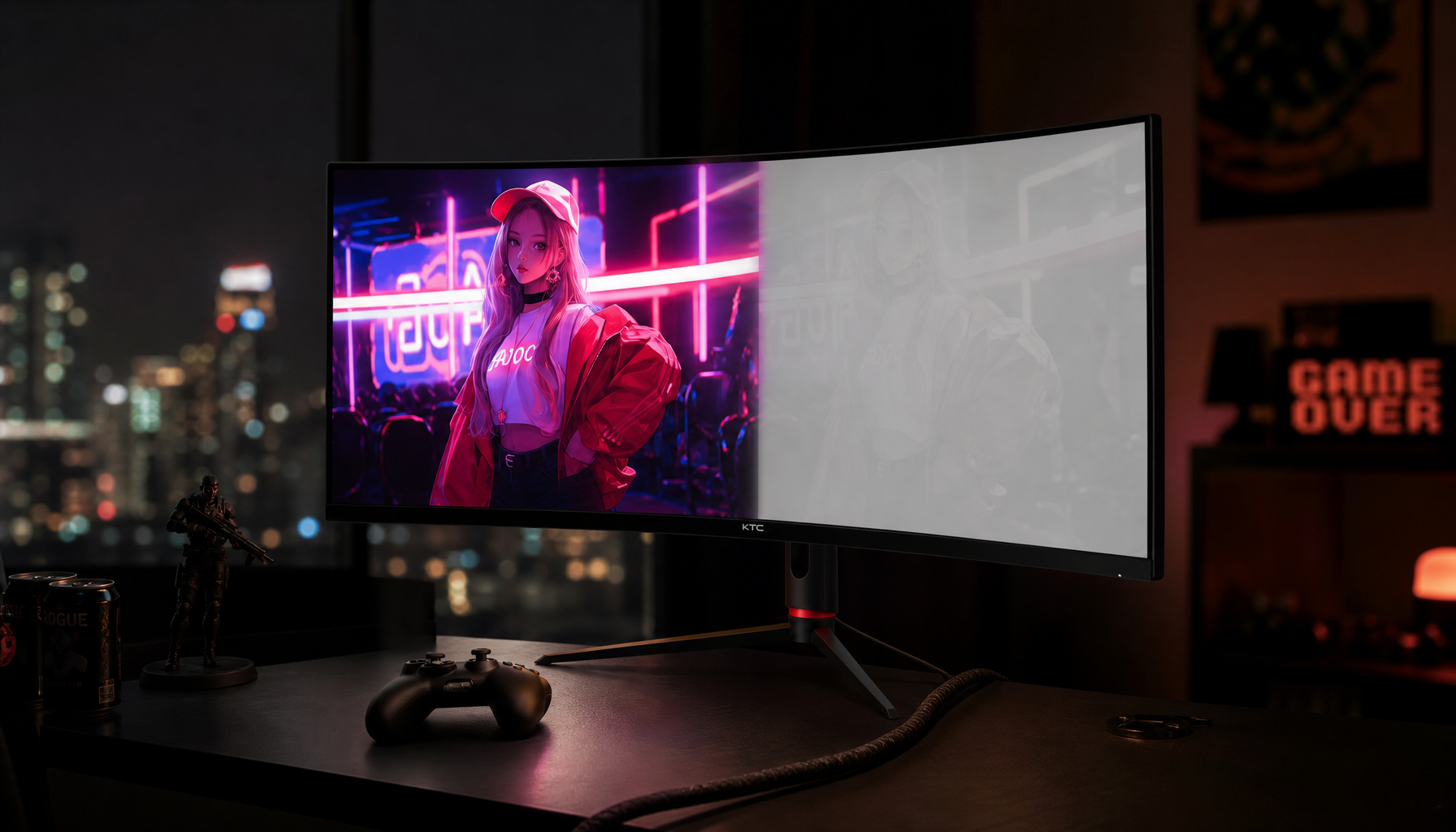
QLED stands for Quantum Dot Light Emitting Diode. Unlike self-emissive OLED panels, it is an enhancement layer—usually a quantum dot enhancement film (QDEF)—placed between a blue LED backlight and the LCD panel. This film converts blue light into precisely tuned red and green wavelengths.
The science rests on semiconductor nanocrystals whose emitted color depends on their physical size. Smaller dots produce blue-shifted light; larger ones shift toward red. As explained in this official NSF overview of quantum dots, the 2023 Nobel Prize in Chemistry recognized this discovery for enabling precise control of light at the nanoscale. Standard white LED backlights rely on broader yellow phosphor that mixes with blue, resulting in less pure colors and lower efficiency for wide color gamuts.
This nanoscale filtering is what separates QLED from traditional LCD monitors. It does not make the panel self-emissive, but it dramatically improves how efficiently the backlight translates into on-screen color and brightness. For further reading on why wide color coverage matters in gameplay, see our guide to Why a Wide Color Gamut Matters for Gamers?.
How Quantum Dots Transform Color Accuracy and Peak Brightness
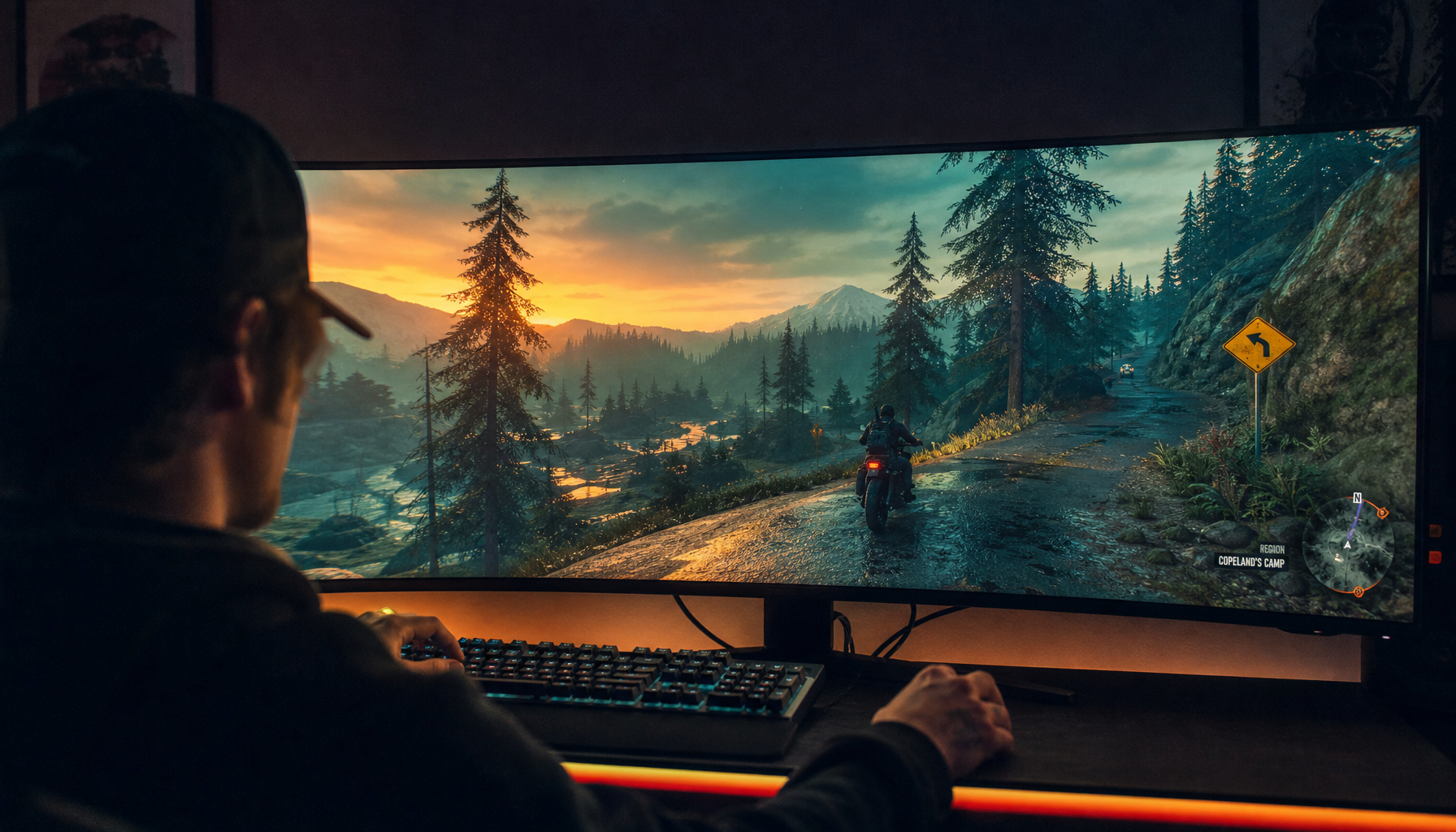
Quantum dots primarily expand color volume—the range of saturated colors a display can produce at different brightness levels. Traditional IPS panels often lose saturation as brightness climbs because their broader-spectrum backlight creates spectral crosstalk. QDs act like a spectral scalpel, emitting narrow-band light that aligns cleanly with the LCD color filters.
This efficiency makes it easier to reach the performance targets of higher VESA DisplayHDR tiers. According to the official VESA DisplayHDR performance criteria, HDR 600 and HDR 1000 certifications typically require at least 90% DCI-P3 coverage alongside sustained luminance levels that are difficult to hit without quantum dots. The result is more impactful HDR in games and video without washing out bright highlights.
In practical terms, a QLED monitor can maintain vivid reds, greens, and blues even at high luminance (600–1000 nits), whereas many standard LCDs may shift toward pastel tones under the same conditions. This matters for content creators who need reliable color representation across varying screen brightness. Our article on What Delta E Values Actually Mean for Your Creative Work explains how these color metrics translate to real editing workflows.

QLED vs. Standard IPS: Why Traditional LCDs Face Limitations
Standard IPS monitors using conventional LED backlights face clear efficiency limits. Achieving 600+ nits often requires higher power draw, generates more heat, and still struggles to maintain a wide color gamut without significant light loss. QLED's quantum dot layer improves light transmission, letting manufacturers hit brighter peaks while preserving color purity.
A second advantage appears in Mini-LED implementations. When local dimming zones are used to boost contrast, non-QD systems can produce yellow-tinted halos around bright text or UI elements on dark backgrounds—known as chromatic blooming. Quantum dots can mitigate this by making the unintended light more color-neutral, reducing visual distraction. While this does not eliminate blooming entirely (the physical halo from finite zones remains), it often makes the effect less noticeable in productivity apps.
For enthusiasts upgrading from basic edge-lit IPS displays, QLED has become a standard step up. It pairs especially well with high-zone Mini-LED backlights. Compare panel fundamentals in our breakdown of IPS vs VA Panels: Which is Right for Your Playing Style? or explore backlight upgrades in Mini-LED IPS vs. Standard IPS: Is the Advanced Backlight Worth the Upgrade?.
2026 Monitor Buying: Utility vs Immersion by Panel Type
A bounded comparison of where Mini-LED QLED-style monitors and OLED monitors tend to fit best, with 1152 local-dimming zones treated as the practical threshold for the stronger Mini-LED lane.
View chart data
| Category | Mini-LED QLED (≤576 zones) | Mini-LED QLED (around 1152 zones) | OLED |
|---|---|---|---|
| Utility / bright-room work | 4.0 | 6.0 | 5.0 |
| Balanced mixed use | 6.0 | 8.0 | 6.0 |
| Immersion / dark-room gaming | 5.0 | 6.0 | 9.0 |
| Local-dimming threshold | 2.0 | 4.0 | 0.0 |
The chart above visualizes the utility-versus-immersion split based on common usage scenarios and review patterns. Higher scores indicate better suitability for that usage. Notice how Mini-LED QLED with high zone counts (such as 1152 zones) often pulls ahead in bright-room and mixed productivity scenarios, while OLED typically leads in pure dark-room immersion. The local-dimming column highlights why zone count is a significant factor for productivity.
QLED vs. OLED: Navigating the Modern Display Landscape
The choice between QLED (typically Mini-LED backlit) and OLED depends heavily on your environment and workflow. OLED delivers perfect per-pixel blacks and zero blooming in completely dark environments, which remains compelling for cinematic or horror gaming. However, its lower sustained full-screen brightness and potential for burn-in make it less ideal for long productivity sessions with static UI elements.
QLED Mini-LED monitors counter with higher peak brightness that punches through ambient light and complete immunity to burn-in. In sunlit offices or rooms with windows, a high-luminance QLED can deliver a more consistent HDR experience than many OLEDs. For users spending eight or more hours daily in IDEs, spreadsheets, or browsers, the absence of burn-in anxiety is a significant practical advantage.
In recent years, the value proposition has favored QLED for hybrid use. A well-specced Mini-LED model often matches the perceived vibrancy of more expensive displays in bright rooms. Explore the details in our comparison MiniLED vs. OLED: Which Display Technology Wins for Gaming? and our hybrid-use guide.
Buying Criteria: Is a QLED Gaming Monitor Right for Your Setup?
Look beyond the “QLED” marketing label and check three practical thresholds. First, confirm genuine quantum dot implementation by verifying at least 90% DCI-P3 coverage in the spec sheet—lower gamut claims may indicate a less effective implementation. Second, remember that HDR quality is a synergy: QLED provides the color, but the HDR effect also depends on the backlight (Mini-LED), the number of local dimming zones, and the manufacturer's tuning.
While there is no universal "hard" threshold, many users find that higher zone counts (such as 1,000+) provide a more seamless experience for productivity by reducing noticeable blooming. Third, match the monitor to your actual usage. Hybrid users who split time between bright-room work and gaming benefit most from QLED’s longevity and brightness. Pure dark-room enthusiasts sensitive to any haloing may still prefer OLED despite the higher maintenance requirements.
Additional factors to consider include the "toggle tax" of switching HDR and local-dimming modes between work and play, plus potential minor input-lag increases when aggressive dimming is enabled. For deeper context on HDR implementations, review What Is the Real Difference Between Native and Emulated HDR on Gaming Monitors?.
Recommended KTC models that meet these criteria include the KTC Mini LED 27" 4K 160Hz HDR1400 Gaming Monitor | M27P6 with 1152 zones and the KTC Mini LED 27" 180Hz 2K HDR1400 Gaming Monitor | M27T6. Both deliver strong quantum dot performance. Browse the full All-Mini-LED Monitors collection to compare options.
If the price gap to a comparable OLED is significant, or if you work in variable lighting, a properly specced QLED Mini-LED is typically the more rational long-term choice for most users.
Frequently Asked Questions
Does QLED improve gaming performance beyond color and brightness?
QLED itself does not reduce input lag or motion blur; those depend on the panel’s refresh rate, response time, and overdrive tuning. The technology mainly benefits gaming through more vibrant HDR scenes and better visibility in bright rooms. Competitive players should still prioritize low-latency modes and check if enabling local dimming adds noticeable lag in their specific titles.
Can a QLED monitor achieve true professional-grade color accuracy without extra calibration?
While many QLED monitors ship with good factory calibration, professional work in photography or video editing usually requires hardware calibration. Quantum dots help reach wide gamut targets, yet final accuracy also depends on backlight uniformity and panel quality. Treat out-of-box performance as strong for enthusiasts, but verify with a colorimeter for color-critical tasks.
Is QLED worth it if I mostly play in a dark room?
In pitch-black environments where blooming is most visible, OLED’s perfect blacks often deliver a more immersive experience. QLED remains competitive if your room has any ambient light or if you value burn-in immunity for mixed productivity use. The decision often comes down to whether your setup is closer to a "daylight warrior" or "dark-room specialist" scenario.
How do I spot weak QLED implementations in monitor listings?
Check the actual color gamut specification rather than just the QLED badge. Models claiming QLED but listing lower DCI-P3 coverage (e.g., below 85-90%) may not be utilizing the technology to its full potential. High-performance QLED pairings usually advertise 95%+ DCI-P3 alongside HDR 600 or higher certification and a robust local-dimming system.
Will QLED monitors become obsolete as other technologies evolve?
While technologies like QD-OLED continue to mature, Mini-LED QLED retains distinct advantages in maximum sustained brightness, burn-in resistance, and cost-effectiveness at mid-range price points. For users who need a reliable daily driver for both work and play, QLED is expected to remain a pragmatic and popular choice for the foreseeable future.