




What is FALD and how does Mini-LED improve it?
Full-Array Local Dimming (FALD) divides the backlight into a grid of zones that can be dimmed or turned off independently to improve contrast in HDR content. Traditional FALD used larger LEDs, which typically limited zone density to dozens or low hundreds. Mini-LED improves this dramatically by using much smaller 100–200 micron chips, enabling significantly higher zone density within the same panel area.
This higher density allows for more granular control. When a zone turns completely off, it can produce deep blacks in that specific area, creating very high effective contrast ratios in scenes with mixed bright and dark elements. As the official VESA DisplayHDR 1.2 specification explains, updated standards now include stricter tests for active dimming performance and subtitle luminance flicker to ensure consistent real-world behavior across different implementations.
The result is a display capable of reaching high peak brightness—often exceeding 1000 nits in premium models—while maintaining deep blacks. This makes HDR content more impactful without the permanent burn-in risk associated with self-emissive technologies like OLED.

Understanding the bloom/halo tradeoff in gaming monitors
Blooming, also called the halo effect, occurs when light from an active zone spills into neighboring dark zones, creating a visible glow around bright objects on dark backgrounds. This happens because each zone is still larger than a single pixel; a small bright star or a line of white text can trigger an entire zone (or group of zones) to light up.
The severity of blooming depends on both zone size and the panel's native contrast. Based on common reviewer observations, VA panels tend to block light more effectively than IPS panels due to their liquid crystal alignment, which can reduce visible halos even when zone counts are identical. IPS panels, while offering wider viewing angles and better color consistency, have lower native contrast and therefore rely more heavily on sophisticated local dimming algorithms to compensate.
In gaming, blooming is most noticeable during dark cinematic scenes or with high-contrast UI elements. While a well-implemented system minimizes these artifacts, no current local dimming solution completely eliminates them in every possible scenario.
How many local dimming zones are enough for gaming?
Zone count alone does not guarantee superior picture quality. The final experience is a combination of zone density, panel type, and the sophistication of the dimming algorithm. For 27–32 inch monitors, performance generally scales across several practical tiers based on current market trends:
- Entry-level HDR: Approximately 576 zones. This provides a noticeable step up from edge-lit displays but may still show visible blooming in challenging scenes.
- Mid-range Performance: Approximately 1,152 zones. In the 27–32 inch category, this is often considered a "sweet spot" for mixed gaming and media use. It typically provides enough precision to control blooming in most scenarios without the extreme processing overhead of higher-density arrays.
- High-end Enthusiast: 2,304+ zones. These models aim for the highest precision, though they require highly optimized algorithms to avoid issues like backlight lag or "black crush" (where fine dark detail is accidentally dimmed).
This TFTCentral report on 2026 Mini-LED monitors highlights how manufacturers are targeting these higher zone densities to close the visual gap with OLED while maintaining the brightness advantages of LCD technology.
Mini-LED Local Dimming Zone Tiers for Gaming
A decision-oriented comparison of Mini-LED zone-count tiers for gaming monitors in 2026. The chart highlights the likely balance between blooming reduction and algorithm complexity, with panel-type nuance for VA and IPS use cases. Higher zone counts can reduce blooming, but the practical jump from the mid-range tier to high-end tiers is often smaller than the jump in cost, processing demands, and tuning difficulty.
View chart data
| Category | Blooming Risk | Contrast Score | Algorithm Demand |
|---|---|---|---|
| 576 zones (Entry) | 7.0 | 6.0 | 4.0 |
| 1152 zones (Sweet Spot) | 4.0 | 8.0 | 7.0 |
| 2304+ zones (High-end) | 2.0 | 9.0 | 10.0 |
The chart above visualizes these trade-offs. While higher zone counts are generally better, the 1,152-zone tier often offers a strong balance of contrast performance and algorithm stability, making it a practical choice for many gamers.

Mini-LED vs OLED contrast comparison: A factual look
Mini-LED can achieve extremely high contrast ratios in scenes where zones can be completely powered down. However, unlike OLED, this is not a "per-pixel" infinite contrast. Because each Mini-LED zone covers thousands of pixels, the "infinite" black level is scene-dependent and subject to the limitations of the zone grid.
OLED delivers true per-pixel control with no light leakage between adjacent pixels, creating perfect blacks at the individual pixel level. Conversely, Mini-LED holds a significant advantage in peak and full-screen brightness. Many Mini-LED panels can sustain over 1000 nits in areas where OLED panels might be limited by thermal management or brightness limiters (ABL) to protect the organic material.
As explained in this TFT Central analysis of OLED and LCD brightness perception, OLED can appear subjectively brighter in dark scenes due to its perfect blacks, while Mini-LED excels in overall luminance and longevity without the risk of permanent image retention.
How to choose the right zone count for your setup
Your viewing environment, content type, and panel preference should guide your decision more than chasing the highest raw zone number.
- Dark-Room Cinema & Immersive Gaming: Consider prioritizing a VA panel with at least 576 zones. The higher native contrast of VA helps mask blooming more effectively, delivering an experience that can feel closer to OLED in many cinematic scenes.
- Competitive Gaming & Bright Rooms: IPS panels with 1,152 or more zones are often preferred here. The wider viewing angles and typically faster pixel response times are beneficial for esports, while the higher zone count helps compensate for the IPS panel's lower native contrast.
- Productivity & General Use: In bright rooms, Mini-LED's high peak brightness and lack of burn-in risk make it a versatile choice. In these environments, the exact zone count is often less critical than the overall quality of the anti-reflective coating and the dimming algorithm's stability.
When shopping, look for VESA DisplayHDR 1.2 certification. This standard requires specific testing for subtitle flicker and active dimming behavior, which helps identify displays with well-tuned algorithms rather than those relying solely on high zone counts for marketing.
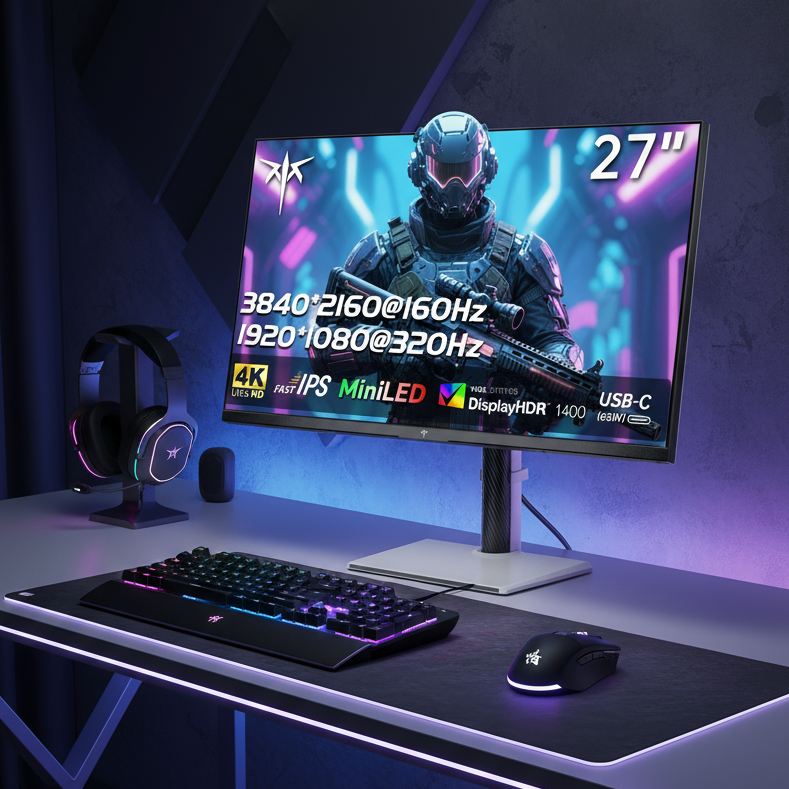
For a strong balance of performance and value in a 27-inch 4K gaming monitor, the KTC Mini LED 27" 4K 160Hz HDR1400 Gaming Monitor | M27P6 serves as a prominent example of the 1,152-zone configuration in action.
FAQs
How many local dimming zones are enough for gaming? For most 27–32 inch gaming monitors, 1,152 zones is a widely recommended target. It generally provides a significant reduction in blooming without the excessive processing demands or cost of 2,000+ zone designs. However, the "right" number depends on how well the manufacturer has tuned the dimming algorithm.
Does more local dimming zones always mean better contrast? Not necessarily. While more zones allow for finer control, a well-tuned 1,152-zone VA panel can often outperform a poorly implemented higher-zone IPS panel. The native contrast of the panel and the speed of the dimming algorithm are just as important as the raw zone count.
What is FALD in Mini-LED monitors? FALD stands for Full-Array Local Dimming. Mini-LED is an evolution of this technology that uses much smaller LEDs to pack hundreds or thousands of zones into the backlight, allowing for much more precise control over dark and light areas compared to traditional FALD.
Is Mini-LED contrast as good as OLED? Mini-LED offers excellent contrast that can appear near-perfect in many scenes, but it lacks OLED's per-pixel precision. Mini-LED is superior for high-brightness environments and longevity, while OLED remains the leader for absolute black depth and zero blooming in dark rooms.
Do VA panels reduce blooming better than IPS with Mini-LED? Generally, yes. Because VA panels have a higher native contrast ratio (often 3000:1 to 5000:1 compared to IPS's 1000:1), they are better at "hiding" the light that leaks from an active Mini-LED zone, resulting in less visible blooming.
What should I check first when buying a Mini-LED monitor? Focus on the combination of panel type (VA for contrast, IPS for angles/speed), VESA DisplayHDR certification, and reputable third-party reviews. Reviews are essential to see how the dimming algorithm handles real-world content like moving subtitles or fast-paced gaming UI.



%20divides%20the%20backlight%20into%20a%20grid%20of%20zones%20that%20can%20be%20dimmed%20or%20turned%20off%20independently%20to%20improve%20contrast%20in%20HDR%20c...
)