A display color profile can deliver accurate color only when the operating system, application, graphics path, and monitor mode all handle it correctly. When one link ignores or misapplies the profile, colors may look oversaturated, dull, washed out, or inconsistent.
Does the same product image look vivid in your editing app, neon in a browser window, and strangely flat after HDR starts? Comparing the same image in a color-managed app and an unmanaged one can quickly reveal whether the problem follows the software rather than the panel. Here is how to identify the weak link, restore dependable color, and choose the right level of calibration for gaming, office work, or color-critical production.
Why Correct Color Can Change From One App to Another
A monitor does not inherently know what a file’s red, green, or blue values were meant to look like. A color profile describes how a display reproduces color, allowing compatible software to translate image values into an appropriate appearance for that specific screen.
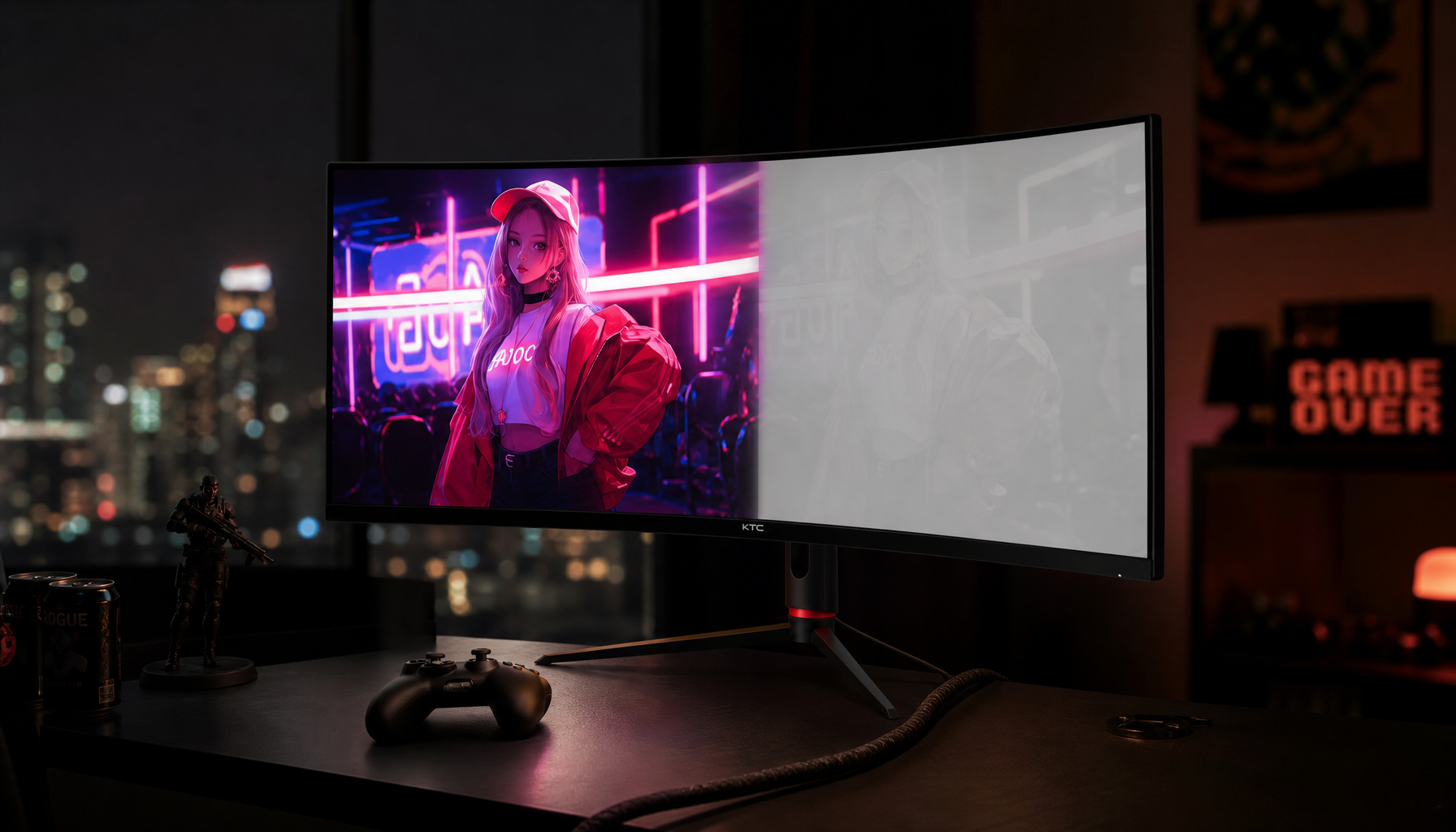
The critical difference is application support. A color-managed application reads the image profile and compensates for the display profile before outputting the image. A non-color-managed application may simply send raw color values to the screen. On a standard sRGB-oriented display, the mismatch may be modest. On a wide-gamut gaming or creator monitor, it can be immediate and dramatic.
Consider a wide-gamut monitor showing an sRGB web image. In a properly managed photo editor, a red jersey should remain close to its intended shade. In an app that treats the same RGB numbers as if they were intended for the monitor’s larger native color space, that jersey may appear aggressively red and overcooked. The monitor is capable of richer color, but the application is using that capability without translation.
This is why a high-performance panel can expose software limitations more visibly than an ordinary office display. More gamut is valuable for HDR content, modern games, video, and design, but only when the workflow controls it.
What a Display Profile Does, and What It Cannot Do
An ICC display profile is a description of a monitor’s measured color behavior. It can characterize white balance, tonal response, and the relationship between requested colors and colors actually displayed. Color profiles standardize appearance because identical numeric color values do not otherwise guarantee identical visual results across different screens.
That description is not the same thing as calibration. Calibration changes the display or signal path toward a target, such as a neutral white point and predictable gamma. Profiling records how the display behaves after setup so color-aware applications can compensate accurately. This distinction matters: a correct profile cannot force an application that ignores profiles to suddenly become color managed.
A useful real-world example is a design prepared in sRGB for broad web use. sRGB remains the dependable compatibility target for ordinary web assets, while Display P3 provides a wider color range for supported displays and content. If a P3-capable screen is running in native wide-gamut mode and a non-aware app shows the sRGB asset directly, vibrant interface accents or product colors may become exaggerated. If the same asset is viewed through properly color-managed software, the wider monitor can reproduce the intended color without turning it into something else.
Workflow Element |
What It Does Well |
What It Cannot Guarantee |
Factory preset |
Provides a usable starting point |
Accuracy after aging, room changes, or mixed apps |
ICC display profile |
Describes monitor behavior for aware apps |
Correct rendering in apps that ignore profiles |
Creates repeatable measured output |
Fixes for poor panels or unmanaged applications |
|
sRGB monitor mode |
Improves consistency in unmanaged apps |
Full use of a wide-gamut display’s richer color range |
Why Wide-Gamut and HDR Displays Reveal the Problem Faster
Modern pro gaming monitors and creator displays increasingly cover color spaces wider than sRGB. That supports richer HDR gaming, more convincing cinematic color, and stronger creative workflows. Yet a wide-gamut display can also make unmanaged content look wrong more obviously because it can produce colors beyond the range the file or app expected.
This creates a tradeoff. Setting a wide-gamut monitor to an sRGB mode can make ordinary desktop applications and unmanaged viewers behave more predictably. The downside is that you temporarily give up part of the monitor’s native color capability. A practical workaround is to use sRGB mode when non-color-managed applications must remain in the workflow.
HDR adds another layer. HDR display controls affect high dynamic range playback and display behavior, but SDR applications, HDR apps, graphics drivers, and monitor firmware may not all transition cleanly between modes. One reported case involving a KG241YS monitor showed a washed-out gray image with HDR enabled immediately after startup; toggling HDR off and on restored normal output. The owner had already tried a clean GPU driver reinstall, monitor firmware, a different display cable, and a startup setting change, so the most plausible direction was an HDR initialization or compatibility regression rather than a simple cable fault.
For a player with a 165 Hz HDR gaming screen, a gray-looking desktop at boot does not prove the panel has lost color accuracy. If color returns after an HDR toggle while the same games and test images look normal afterward, the failure may be in startup handling rather than the monitor’s fundamental capability.
Why the Operating System Can Make a Sound Setup Feel Unreliable
Display color is not controlled in one location. Display settings, HDR controls, ICC profile assignment, legacy color management tools, GPU software, and app-specific behavior can each influence what reaches the panel. Color management controls are therefore powerful but fragmented, especially once HDR and wide-gamut use are involved.

A notable reported edge case concerns GPU-rendered applications on a wide-gamut PA329 monitor. After operating system updates, the user found that multiple apps appeared desaturated, while disabling GPU rendering in two apps restored richer color. A photo editor improved after its RGB workflow was pointed to the monitor-specific profile. This is not enough to prove one universal bug for every system, but it is enough to justify a targeted test: if the same content changes appearance when hardware acceleration is disabled, the application-to-GPU color path deserves attention before you start replacing hardware.
The practical lesson is to isolate variables. If every app, the BIOS splash screen, and on-screen monitor menus show abnormal color, consider panel, cable, GPU, or display-mode faults. If only one viewer or browser looks wrong while a known color-managed editor appears correct, application color handling is the stronger suspect. If the desktop looks washed out only when HDR is active or only after boot, test the HDR and driver path before altering a trusted profile.
A Reliable Troubleshooting Sequence
Start With a Known Image and Two Applications
Use one familiar image with natural skin tones, neutral grays, and saturated colors, or a project file you have judged on a trusted display. Open it in a color-managed editing application and in the app that appears wrong. If the mismatch is large on the same monitor, under the same lighting, at the same moment, the monitor alone is unlikely to explain it.
For a gaming setup, a useful comparison is a captured in-game scene with dark shadow detail and vivid HUD colors. For office productivity, use a brand presentation or a product image displayed in the browser and in the authoring tool. The goal is not aesthetic preference; it is repeatability.
Confirm the Correct Monitor Profile and Display Mode
Make sure the correct profile is assigned to the correct display, particularly in a dual-monitor workstation where a laptop panel, portable screen, and external monitor may each require different characterization. An ICC profile made for one unit is not automatically accurate for another, even if both screens share the same model name.

Before judging any profile, disable color-shifting features used for comfort or power savings. Night Light deliberately warms colors, and dynamic contrast, eco brightness, aggressive gaming presets, or automatic brightness can undermine stable comparison. When the work is color critical, steady settings matter more than a punchier demo appearance.
Test sRGB Mode When Unmanaged Apps Must Be Used
If your primary problem is extreme saturation in ordinary apps on a wide-gamut monitor, switch the monitor temporarily to sRGB mode and compare again. This is a strong diagnostic step: if unmanaged applications suddenly become visually closer to color-managed ones, the native gamut was exposing the app’s lack of compensation.
The cost is clear. Native gamut or a wider creative mode preserves richer color range for supported games, HDR experiences, and properly managed production tools; sRGB mode favors consistency for broadly distributed office, browser, and web content. A practical workflow may use sRGB for routine desktop output, then return to a calibrated wide-gamut or HDR mode for supported creative or entertainment content.
Separate SDR Profile Problems From HDR Problems
Do not use an SDR ICC profile problem to explain every HDR symptom. HDR is a separate rendering path with brightness mapping, color volume, driver support, and application behavior involved. If SDR files appear accurate until HDR is enabled, or the display is only washed out after HDR startup, focus testing on HDR configuration, calibration tools, driver versions, app HDR support, and display firmware behavior.
A gamer may reasonably keep HDR disabled on the desktop and enable it only for supported titles if that produces stable output. An editor delivering HDR video has a stricter requirement: the HDR pipeline must be validated rather than worked around, because incorrect highlights or color decisions can pass into delivered content.
When Hardware Calibration Is Worth the Investment
Software-level setup is usually sufficient for email, spreadsheets, dashboards, streaming, casual gaming, and travel monitor use. For those workloads, a stable preset, correct system settings, and sensible brightness often provide the right value balance.
The decision changes when incorrect color carries a cost. Hardware calibration is recommended when a color mistake can trigger client revisions, failed product approvals, inconsistent branding, or a reprint. A calibration device priced in the $150.00 to $300.00 range becomes rational protection if one incorrect approval could cause a $250.00 reprint or schedule delay.
For multi-display creator work, calibration also reduces distraction. A photo editor comparing an image on a main monitor and a portable preview display should not have to guess which version of a neutral gray is credible. Even identical monitor models can differ in brightness, tint, uniformity, and gamut response. Measurement offers a controlled baseline, though it still does not compel unmanaged software to obey a profile.
Hardware calibration has limits. It adds cost and setup discipline, requires compatible software and possibly internal monitor lookup-table support, and cannot transform a limited or uneven panel into a reference-grade display. Its advantage is repeatability: it gives serious workflows a measured starting point rather than a chain of visual guesses.
Matching the Fix to Your Display Workflow
For competitive gaming, the priority is stable mode behavior, readable shadow detail, low latency, and consistent SDR or HDR activation. Settle the display in a neutral gaming or sRGB-compatible preset first, then validate HDR title by title rather than assuming a desktop HDR setting benefits every game and app.
For office productivity, consistency is usually more important than maximum gamut. A browser, spreadsheet, presentation app, and portable second screen should show brand colors and charts predictably. An sRGB-oriented configuration is often the most reliable operating mode, especially when documents will be shared widely across unmanaged devices.
For photo, design, product merchandising, and video workflows, use a color-managed application, a measured profile, a stable room environment, and hardware calibration when decisions affect payment or publication. Different screens reproduce color differently, and no monitor feature list removes the need to control the viewing and software pipeline.
Frequently Asked Questions
Does an Expensive Monitor Prevent Incorrect Colors in Every App?
No. A premium wide-gamut or HDR display may reveal errors more clearly because it can show a wider and brighter range of output. Accurate results still depend on the application, operating system, active display mode, graphics path, and profile handling.
Should a Wide-Gamut Monitor Always Be Set to sRGB?
No. sRGB mode is valuable when unmanaged desktop applications must look consistent or when preparing standard web content. Native wide-gamut, P3, or HDR modes are valuable when supported content and properly managed applications can use the additional color range.
Can a Cable Cause Incorrect Color?
A damaged cable or connection problem can cause artifacts, signal instability, or mode negotiation trouble, so it is a reasonable hardware check. However, when one application looks wrong and another looks correct on the same live display, software color handling is typically a more direct explanation than the cable.
Why Do Colors Change After Enabling HDR?
HDR shifts the display into a different brightness and color-processing workflow. Unsupported SDR apps, driver behavior, display firmware, or HDR initialization can lead to washed-out or inconsistent appearance until settings are corrected or the mode is reset.
Control the Whole Color Path
Color accuracy is not a checkbox hidden inside a monitor menu. It is a chain from file profile to application, operating system, GPU path, active display mode, and panel behavior. Use sRGB for broad consistency, validated wide gamut and HDR for immersive or creative advantage, and measured calibration when incorrect color carries real cost. A display performs at its best when every part of that chain works deliberately.