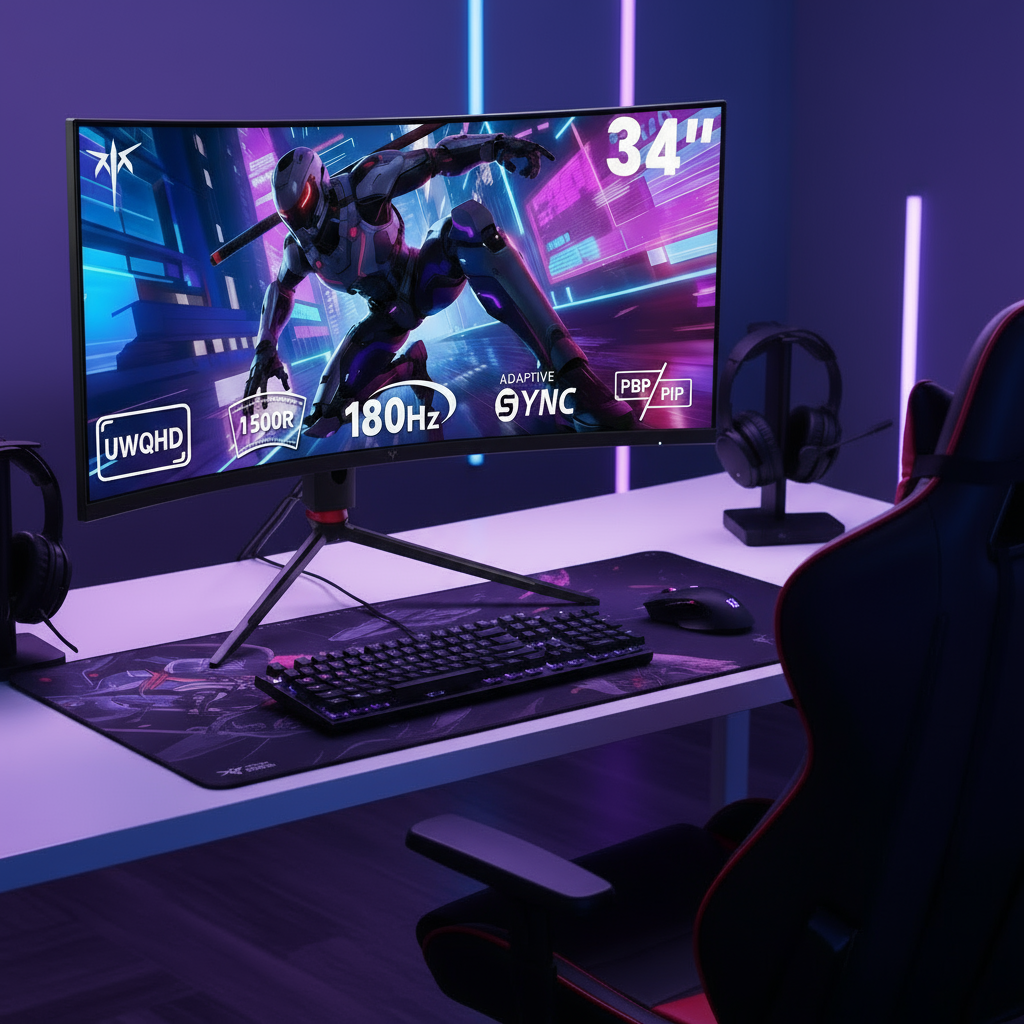




Curved VA panels became common in ultrawide monitors because they combine strong contrast, immersive wraparound viewing, and lower pricing than many IPS alternatives.
Ultrawide Screens Made Curvature More Practical
A 34-inch or 49-inch ultrawide is not just bigger. It stretches your workspace horizontally, often in 21:9 or 32:9 formats, giving you more room for timelines, spreadsheets, code editors, browser windows, and game worlds.

That width is exactly why curvature became useful. On a large flat panel, the edges sit farther from your eyes than the center. A curve pulls those edges inward, making the screen feel more consistent from left to right.
Many ultrawide lineups emphasize 21:9 and 32:9 formats for multitasking and immersive viewing, which helps explain why curved designs grew alongside the category.
VA Contrast Fits the Immersion Pitch
VA panels are known for deeper blacks and stronger native contrast than typical IPS panels. That matters on an ultrawide because the format is often sold as an immersive upgrade, not just a larger desktop.
In dark games, cinematic video, and late-night work sessions, VA contrast gives the image more depth. Black backgrounds look less gray, shadows carry more weight, and full-screen content feels more enveloping.

A practical VA-versus-IPS breakdown notes that VA monitors commonly deliver much higher contrast ratios, while IPS usually wins on viewing angles and color consistency.
That tradeoff shaped the market: VA became the value-forward immersion panel, while IPS stayed attractive for color-critical work and fast competitive gaming.
Cost Made VA the Volume Choice
Curved ultrawides already cost more to build and ship than standard flat 16:9 monitors. VA helped manufacturers keep prices reachable while still offering the headline features buyers wanted: size, curve, high refresh rate, and strong contrast.
That is why many affordable 34-inch gaming ultrawides use VA. They can offer 3440 x 1440 resolution, a high refresh rate, adaptive sync, and a curved chassis without reaching premium IPS or OLED pricing.

One budget ultrawide pick, for example, uses a 34-inch VA panel with 3440 x 1440 resolution and a 165 Hz refresh rate, showing how VA continues to anchor the value tier.
For buyers comparing specs, that often feels like the smarter spend: more screen, more contrast, and more Hz for the dollar.
The Real Tradeoffs Still Matter
VA is not automatically best. It became common because it balances performance and price well, not because it wins every category.
The main compromises are motion smearing in dark transitions, narrower viewing angles than IPS, possible color shifts toward the edges, weaker appeal for competitive esports players who prefer faster IPS or OLED, and less suitability for creative pros who need flat IPS geometry and color consistency.
This is especially important on wide screens, where edge visibility matters. Some monitor communities still debate whether IPS is worth the premium for office use, especially on larger curved displays where viewing consistency becomes more noticeable.
Curved VA works best when you sit centered, use the monitor mostly solo, and value contrast and screen size over perfect off-axis accuracy.

Why It Became the Default
Curved VA panels became the default because they matched what ultrawide buyers were actually chasing: immersion, usable multitasking space, strong blacks, and attainable pricing.
IPS remains better for color-sensitive workflows and wide-angle consistency. OLED is the premium visual option, but it costs more and can raise burn-in concerns for static productivity layouts.
For most gaming and productivity ultrawides, VA became the reliable middle lane: cinematic enough for play, spacious enough for work, and affordable enough to scale across the market.