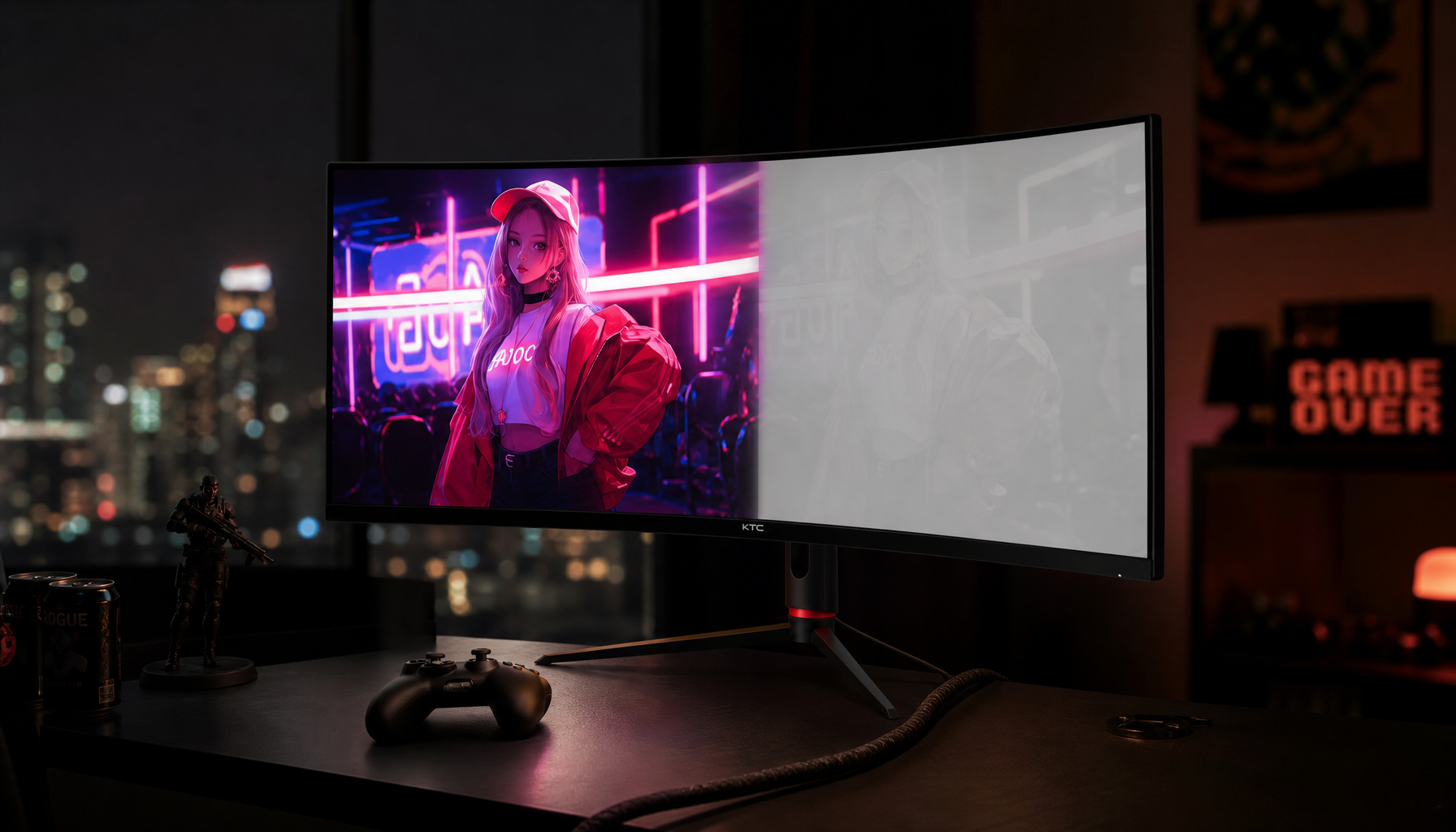
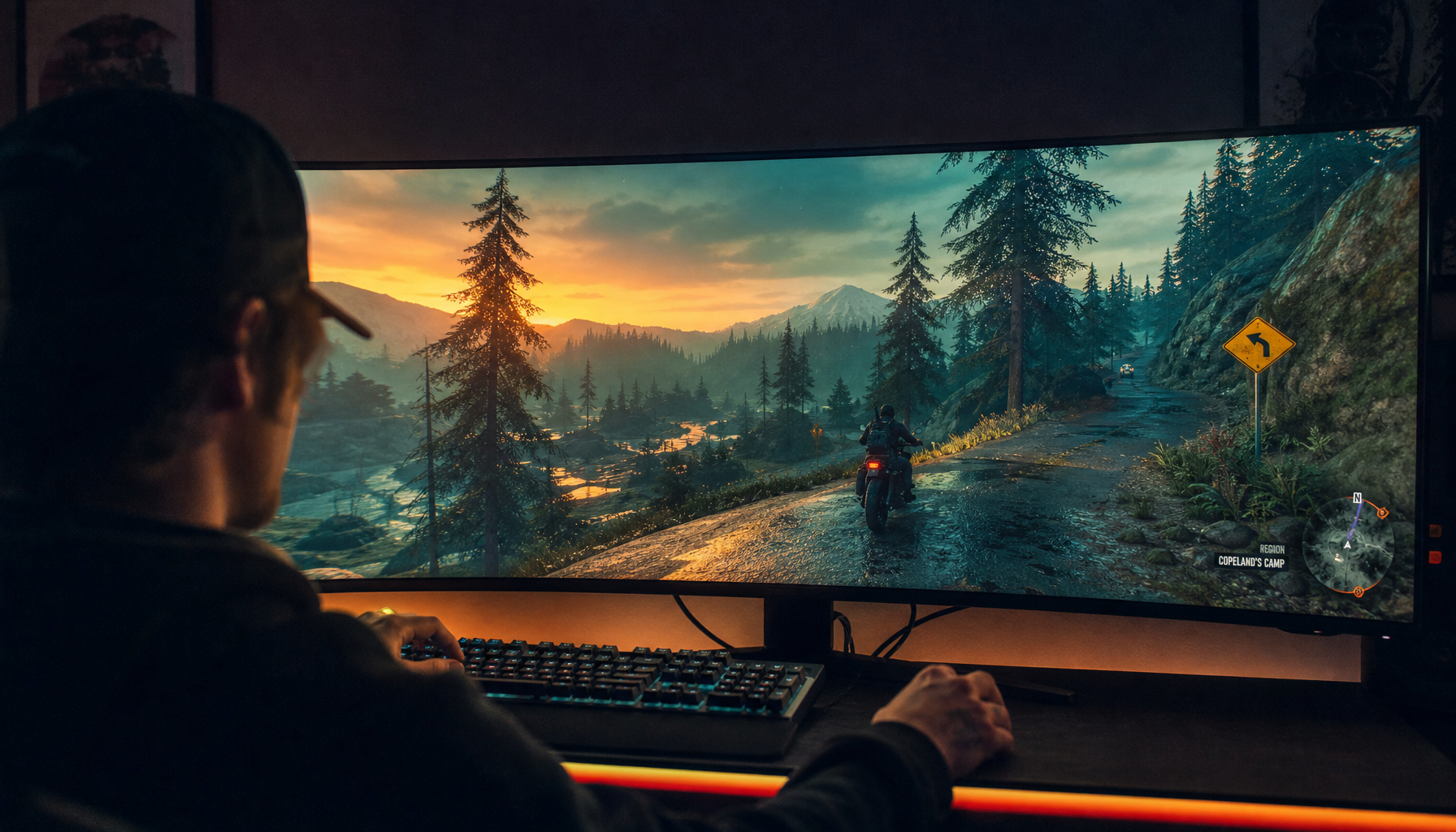
HDR can feel more tiring because it pushes brighter highlights, deeper contrast swings, and wider luminance changes into the same viewing session, forcing your eyes to adapt more often than they do with SDR.
Ever finish a bright HDR game level or movie scene and feel your eyes tighten faster than they do during normal desktop work? A practical setup pass can often reduce the problem immediately: lower peak light output, match the room lighting, and calibrate HDR instead of leaving every brightness slider maxed. You will learn why HDR causes faster fatigue, when it is worth using, and how to tune your monitor for immersion without punishing your eyes.
HDR vs. SDR: The Real Comfort Difference
SDR, or Standard Dynamic Range, is the familiar display range used by most desktop apps, web pages, office documents, and older games. HDR, or High Dynamic Range, expands the gap between dark shadows and bright highlights, so sunlight, explosions, neon signs, snow, reflections, and specular highlights can appear much more intense than they would in SDR.
That wider range is both the appeal and the risk. A normal SDR office monitor might sit around a few hundred nits, while serious HDR displays often target far higher peak brightness. HDR becomes more visually convincing when a display can deliver strong peak brightness, deep blacks, and a wide color gamut; photography-focused HDR guidance often treats 1,000+ nits as the point where HDR becomes especially compelling for highlight realism, especially on capable mini-LED or OLED-class screens.
The eye strain problem is not that HDR is bad. It is that HDR is more demanding. Your eyes constantly adjust to changes in brightness. When a dark cave, black desktop, or shadowy game scene suddenly contains a 1,000-nit torch, muzzle flash, or white subtitle, your pupils and retina are dealing with a much larger contrast jump than they would in SDR.
Why HDR Fatigue Can Arrive Faster
Your Eyes Work Harder in Dark Rooms
HDR often looks best in a controlled room because reflections reduce perceived contrast. The catch is that a dark room makes your pupils open wider. When the average room light is low and the screen throws bright HDR highlights at you, those highlights can feel sharper and more aggressive.
This is why an HDR monitor can feel comfortable in a softly lit office but harsh in a blacked-out gaming room. The solution is not always to make the room bright. It is to raise ambient light enough that your eyes are not adapting from near-darkness to intense screen highlights every few seconds.
A neutral bias light behind the display is often the cleanest fix. It raises the room’s average light level without putting a lamp in your sightline or reflecting off the panel. For a 32-inch gaming monitor, a small neutral-white light behind the desk can make bright HUD elements and HDR sparks feel less piercing while preserving most of the perceived contrast.

Peak Brightness Is Not the Same as Comfortable Brightness
HDR marketing leans heavily on peak brightness, but comfort depends on how that brightness is used. A monitor that can reach 1,000-nit peaks can be impressive, yet running every game, movie, and desktop element at aggressive brightness is a fast route to visual fatigue.
Contrast ratio also matters because it defines the difference between a display’s brightest white and darkest black; a 3000:1 contrast ratio means white output is 3,000 times brighter than black output. Strong contrast can make games and movies more dimensional, but when paired with high peak brightness in a dark room, it also increases the intensity of transitions your eyes must process.
Think of it like audio. A speaker that can get loud is valuable, but you do not listen at maximum volume all day. HDR brightness should be treated the same way: capability is useful, while constant intensity is exhausting.
Always-On HDR Can Make SDR Content Feel Wrong
Many users leave HDR enabled all the time, then wonder why browsing, documents, spreadsheets, and SDR videos look odd or feel harder to view. The operating system may use tone mapping before composing the final desktop image, including when different app windows use different color spaces. That behavior is useful, but it does not guarantee that every SDR app will feel natural on every monitor.
The practical move is simple: use HDR intentionally. Enable it for HDR games, HDR video, and HDR creative review. Turn it off for long writing sessions, spreadsheets, coding, email, and general office work if SDR feels calmer. On many desks, SDR is the productivity mode and HDR is the immersion mode.
The Pros and Cons of HDR for Real Users
HDR Strength |
Why It Helps |
Comfort Tradeoff |
Brighter highlights |
Sunlight, fire, metal, and reflections look more lifelike |
Small bright elements can feel piercing in dark rooms |
Deeper perceived contrast |
Games and movies gain depth and atmosphere |
Fast dark-to-bright transitions can tire the eyes |
Wider color volume |
HDR content can look richer and more dimensional |
Oversaturated or poorly mapped content can feel unnatural |
Better cinematic immersion |
Single-player games and movies can feel more realistic |
Desktop productivity may feel too intense if HDR stays on |
For competitive gaming, HDR is not always the top priority. Fast response time, refresh rate, input lag, and visibility often matter more. Gaming monitor guidance commonly treats refresh rate, response time, adaptive sync, and genre fit as core buying decisions. HDR is a premium visual layer, not a substitute for motion performance.
For office work, HDR is even less essential. Productivity displays are usually judged by text clarity, ergonomics, ports, webcam or docking features, and usable brightness. Business monitor coverage often emphasizes practical workstation features such as ultrawide layouts, USB-C, high-speed docking, webcams, hubs, and warranties. That is a useful reminder: a great HDR screen can still be the wrong daily office screen if it makes static work uncomfortable.
How to Tune HDR So It Stops Hurting So Quickly
Start with the room. If the monitor is the brightest object in a dark space, add soft ambient light behind or beside the display. Avoid overhead glare and avoid lamps that reflect directly on the panel. Eye-care guidance consistently points to matching screen brightness with the surrounding environment, reducing glare, using warmer color temperature when appropriate, and increasing text size for easier reading.
Next, stop maxing every HDR setting. In games, follow the in-game calibration screens and set the white point so bright clouds, snow, or light sources retain detail instead of becoming flat white patches. If a game asks you to adjust until a logo is barely visible, do that carefully in your actual room lighting. A setting that looks dramatic for five minutes can be tiring after 90 minutes.

Then separate modes by task. Use SDR for desktop work, long reading, spreadsheets, and coding. Use HDR for supported games, movies, photo review, and console play. If you use a large OLED TV or a monitor larger than 42 inches at a desk, increase viewing distance where possible and reduce peak light output. A huge, bright display at arm’s length can overload your field of view faster than a 27-inch monitor tuned for desk use.
Finally, build in eye resets. Digital eye strain is tied to prolonged screen use, reduced blinking, close focus, glare, and poor posture, and symptoms can include blurred vision, dryness, headaches, light sensitivity, and eye pain digital eye strain. The 10-10-10 method is a compact option for heavy screen users: every 10 minutes, look about 10 feet away for 10 seconds. For longer sessions, the 20-20-20 rule is also useful and easy to remember.
When HDR Eye Strain Means the Monitor Is the Wrong Fit
If HDR only feels bad on one display, the issue may be the monitor rather than HDR itself. Entry-level HDR-compatible monitors may accept an HDR signal without delivering true HDR-quality brightness control, dimming, or color volume. That can create an image that is simultaneously too bright, washed out, and uncomfortable.
A better HDR monitor usually has meaningful peak brightness, strong contrast, local dimming or pixel-level dimming, wide color support, and competent tone mapping. But better does not always mean brighter for your use case. For office-heavy users, a sharp 1440p or 4K SDR-focused monitor with good ergonomics may be more valuable than a budget HDR panel with harsh brightness behavior.
Persistent discomfort deserves attention beyond display settings. Ergonomics guidance treats eye strain prevention as a combination of workstation setup, lighting control, breaks, and viewing habits. If headaches, pain, light sensitivity, or blurred vision keep happening even after reasonable monitor adjustments, an eye exam is the right next step.
A Practical HDR Comfort Setup
For most users, the best balance is straightforward: keep SDR as the default for productivity, enable HDR only for content that benefits from it, use a calibrated HDR mode instead of maximum brightness, and add soft bias lighting for evening sessions. HDR should make the screen feel more real, not more punishing.
A high-performance display is only doing its job when you can stay immersed, focused, and comfortable. Tune for sustained viewing first; the best HDR experience is the one you can enjoy for the whole match, movie, or creative review without your eyes asking you to quit.