In 2026, startup founders and IT managers face mounting pressure to outfit new offices and co-working spaces without inflating budgets. Retail markups of 30-60% above wholesale, combined with unpredictable tariffs and logistics, often turn what should be a straightforward procurement into a costly bottleneck. Sourcing OEM-direct monitors offers a practical path to lower per-unit costs for orders of 50 units or more, provided buyers account for minimum order quantities, lead times, and a buffer-stock approach to warranty support.

The Startup Procurement Problem: Why Retail Markups Stifle Growth in 2026
Retail channels typically apply per-unit markups ranging from 30% to 60% above wholesale costs due to distributor margins, packaging, and marketing overhead. For a startup scaling from 10 to 50 workstations, this "middleman tax" quickly compounds, limiting how many desks can be equipped or forcing compromises on quality that create future tech debt.
The shift from just-in-time to "just-in-case" inventory further complicates matters. New office buildouts and co-working rollouts require uniform specs across all stations to maintain a professional look and simplify maintenance. Traditional value-added resellers (VARs) often add layers of cost without delivering proportional hardware improvements, making them less attractive when capital efficiency matters most.
This environment pushes procurement teams to evaluate whether local retail still makes sense or if bypassing intermediaries can deliver better total cost of ownership (TCO). The decision hinges on order volume, landed-cost math, and the ability to manage international supply-chain risks.
Vertical Integration Arbitrage: Why OEM-Direct Changes the Math
Vertical integration arbitrage means accessing factory pricing before brand markups and retail overhead are layered on. By purchasing directly from an established OEM, startups gain the same panel technology and core components used in premium-branded monitors, but at a lower base cost.
Consolidating separate small orders into a single bulk purchase typically reduces per-unit prices by 8–18% and slashes administrative overhead by up to 80%. This model works particularly well for companies outfitting 50 or more desks, where the savings on monitors alone can free budget for ergonomic accessories or infrastructure.
KTC serves as a strong example of this approach. As a major OEM with decades of experience supplying global brands, the company offers factory-direct access to reliable hardware while maintaining competitive warranty terms. The same panel DNA found in higher-priced alternatives appears in more affordable models, letting buyers capture value without sacrificing core performance.
That said, the math only favors OEM-direct above certain volume thresholds. Smaller orders can be disadvantaged once tariffs, brokerage, and shipping are factored in, which is why understanding landed cost is critical before committing.
The 2026 Baseline: Non-Negotiable Specs for Modern Workstations
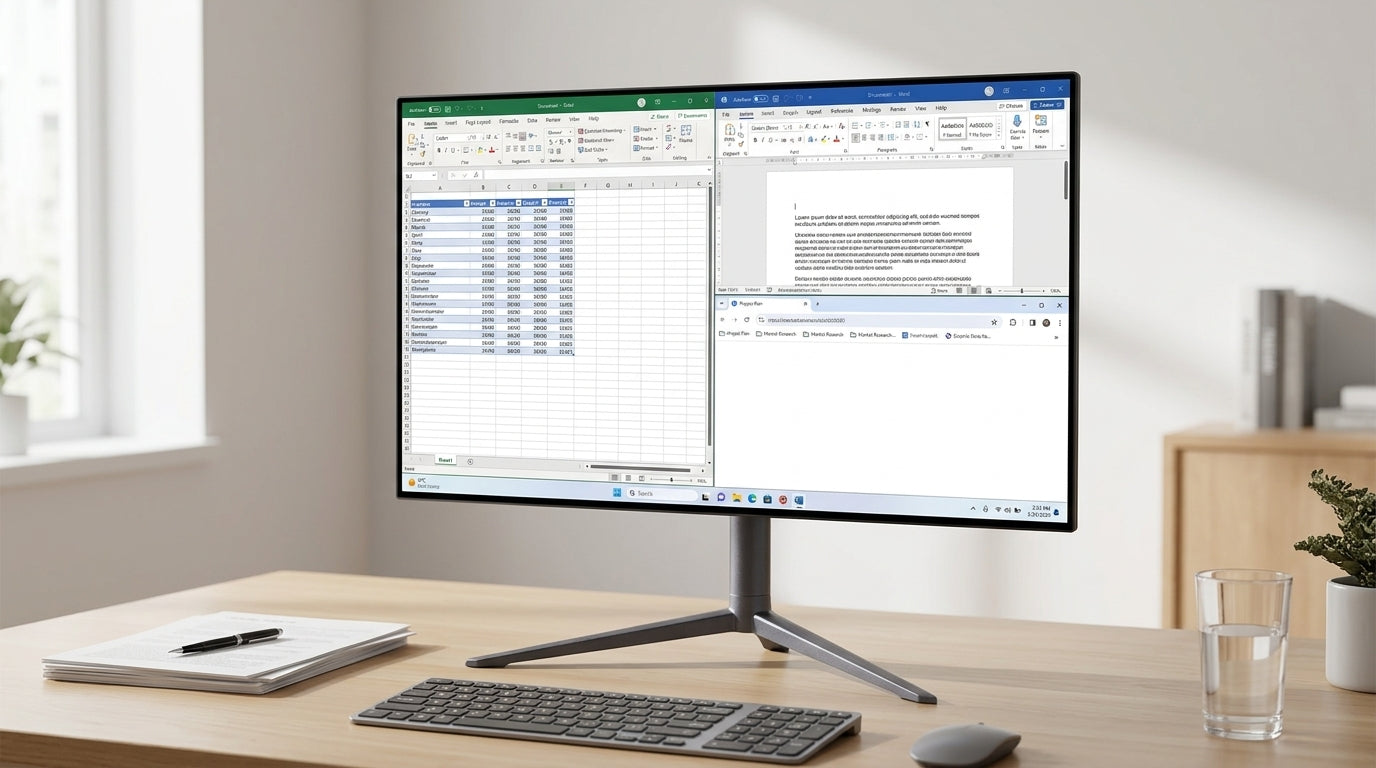
For most startup and co-working deployments in 2026, 100Hz has become the floor for office monitors to reduce eye fatigue during long sessions. A 60Hz panel may still function, but it often feels outdated and contributes to user complaints about strain, especially in open-plan environments where multiple people view screens from varying angles.
IPS panels are non-negotiable for shared workspaces. Their 178° viewing angles and consistent color reproduction prevent the color-shift and brightness drop that VA panels can exhibit off-axis, making them essential for collaborative areas and multi-monitor desks. Pairing IPS with a matte anti-glare finish further improves usability under typical office lighting, as noted in enterprise procurement checklists.
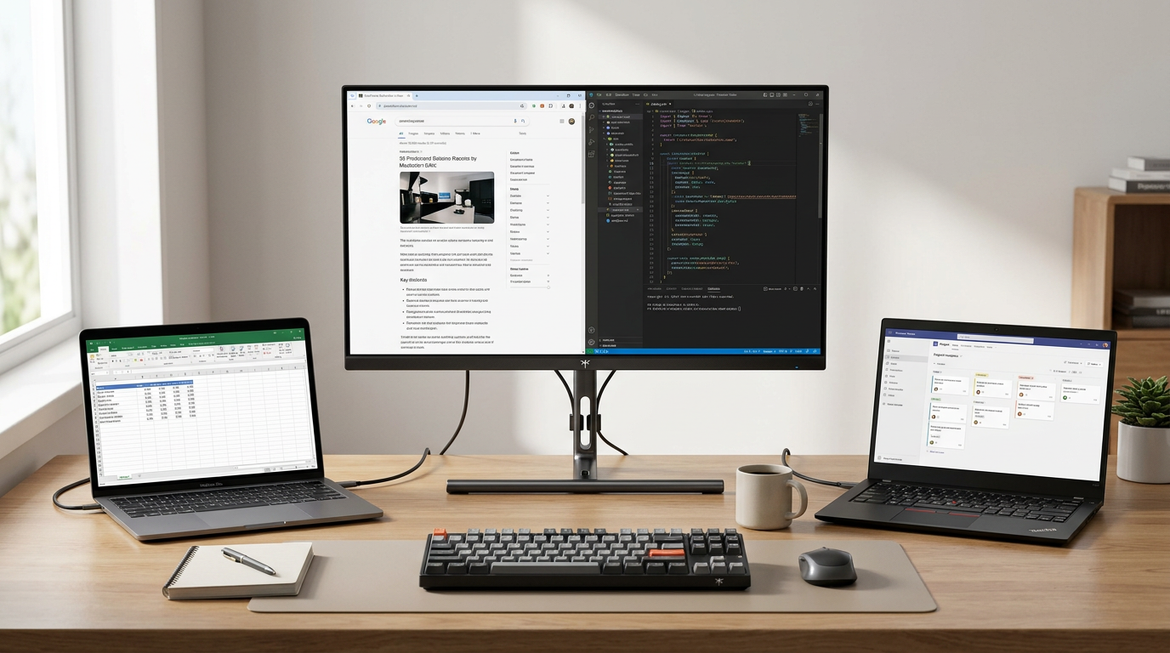
USB-C with 65W or higher Power Delivery delivers a clear TCO advantage. It eliminates the need for separate docking stations at many desks, potentially saving $100 or more per workstation while reducing cable clutter. This feature also supports single-cable connectivity for laptops, streamlining setup during rapid team growth.
Practical baseline candidates from KTC include the H27T27 27" 2K 100Hz office monitor, which meets the 100Hz IPS requirement at an accessible price point, and the H27P27 27" 4K office monitor for teams needing higher pixel density for detailed work. These models align with the minimum specs most startups should target to avoid early refresh cycles.
For additional guidance on building ergonomic and productive workspaces, see our complete guide to finding the best monitor for productivity and how a USB-C monitor can streamline your workspace.

Navigating the Landed Cost: Tariffs, Logistics, and the Break-Even Point
In 2026, procurement leaders must adjust landed-cost models to treat tariffs as a fixed element of the operating context rather than a temporary disruptor. Stacked tariffs and surcharges often exceed 30-40% of CIF value, and the elimination of the $800 de minimis threshold has removed a previous workaround for low-value shipments.
Fixed brokerage fees of roughly $400–600 create a clear penalty zone for orders below 20 units. Even with lower factory pricing, these one-time costs can make small OEM-direct purchases more expensive than local retail once everything is accounted for. Savings of around 15% typically materialize only when orders reach the 50-unit threshold, where logistics efficiencies such as less-than-container-load (LCL) shipping spread fixed expenses more effectively.
The chart below visualizes these tiers:
When OEM-Direct Landed Cost Starts to Beat Retail
The chart shows a tiered break-even view: OEM-direct is still at a disadvantage below 20 units, narrows the gap in the 20–49 unit range, and becomes the cheaper option at 50+ units. Retail pricing is shown as a broad price zone, while OEM-direct landed cost reflects the lower-cost path after volume and fixed-cost effects are spread across more units.
View chart data
| Category | Retail Price (USD) | OEM-Direct Landed Cost (USD) | Savings Percentage (%) |
|---|---|---|---|
| Penalty Zone (<20 units) | 160.0 | 210.0 | 0.0 |
| Fringe Zone (20–49 units) | 160.0 | 180.0 | 0.0 |
| Savings Zone (50+ units) | 160.0 | 140.0 | 15.0 |
This tiered view helps clarify when OEM-direct becomes the stronger choice. Landed costs are estimates based on 2026 Q2 trade policies and may vary by port or carrier. Front-loading shipments during stable logistics windows can further reduce volatility. For deeper context on evolving supply-chain rules, review this 2026 supply chain overview from Digi-Key.
Risk Control: Managing Quality and the 'Self-Insured' Warranty Model
International RMAs remain slow and costly, creating a "warranty trust gamble" that startups must address proactively. Rather than relying on individual repairs shipped overseas, many B2B buyers adopt a replacement-first mindset supported by buffer stock.
Negotiating a 2–5% buffer stock upfront—often called a spare parts pool—allows IT teams to swap failed units immediately without waiting on international shipping. Requesting a small percentage of spare power boards, stands, and cables further simplifies local maintenance. Specifying a strict <3 pixel defect tolerance for the first 30 days in the purchase contract helps ensure incoming quality meets expectations.
KTC's standard 3-year warranty provides a solid baseline, yet the practical strategy for fast-growing companies is to treat the buffer as self-insurance. This approach mitigates the friction of overseas service while keeping total ownership costs predictable. TCO Certified standards can additionally help verify social and environmental compliance when ESG goals are part of the procurement brief.
Our guide on remedying digital eye strain offers complementary advice on selecting displays that support long-term employee comfort in these setups.
The Startup Rollout Checklist: From Quote to Deployment
Follow these steps to move efficiently from inquiry to installed workstations:
- Define a standard workstation spec—such as 27-inch QHD 100Hz IPS with USB-C PD—to ensure consistency across the office.
- Request quotes at the 50-unit threshold to unlock favorable logistics and per-unit pricing.
- Negotiate the 3% buffer stock and any spare component kit as part of the initial contract.
- Calculate the full landed cost (CIF + tariffs + brokerage) and compare it against retail options before signing.
- Standardize deployment with VESA-compatible arms for uniform ergonomics and easier future upgrades.
Treating the order as a partnership rather than a one-off transaction often yields better terms on MOQ and support. For teams exploring broader productivity setups, the vertical vs horizontal dual monitor guide provides useful configuration ideas.
Frequently Asked Questions
What is the typical minimum order quantity for OEM-direct monitors?
Most factories set a baseline MOQ around 20–50 units for standard office models, though this can sometimes be negotiated downward for startups demonstrating long-term volume potential. Starting at the 50-unit level usually delivers the best combination of pricing, shipping efficiency, and support terms.
How long should I expect lead times when ordering direct from the manufacturer?
Typical lead times range from 4 to 8 weeks for production plus 2 to 4 weeks for ocean freight to the US. Air shipping shortens transit but significantly raises landed cost. Build buffer time into your office move schedule to avoid onboarding delays.
Can I still get meaningful savings on orders smaller than 50 units?
Below 20 units, fixed brokerage and tariff costs often erase the per-unit discount, making local retail or distributor bulk programs more practical. The 20–49 unit range is a fringe zone where savings are modest and require careful cost modeling.
How do I handle warranty claims when the manufacturer is overseas?
Plan on a replacement rather than repair model. Negotiate 2–5% buffer stock at purchase so your IT team can swap units locally. Component-level spares for power supplies or stands further reduce downtime. A 3-year warranty remains valuable, but treat it as part of a self-insured pool rather than a traditional RMA process.
What payment and quality assurance terms are realistic for startup buyers?
Letter of credit or 30% deposit with balance on shipment are common. Insist on pre-shipment inspection reports, a defined pixel tolerance policy, and confirmation of TCO Certified or equivalent standards when sustainability matters. Request samples of the exact production batch before committing to full volume.
Should I prioritize USB-C Power Delivery in my bulk order?
Yes, for most modern office setups. 65W+ USB-C PD eliminates separate docks for many laptops, reducing both hardware and cable-management costs. It also simplifies hot-desking in co-working environments. Confirm the monitors you select deliver stable power output under load before finalizing the specification.
Are there sustainability certifications I should require from an OEM supplier?
TCO Certified remains the leading global standard for socially responsible manufacturing, hazardous-substance reduction, and circular design. Request proof of certification or equivalent documentation, especially if your company reports on ESG metrics or serves clients with strict procurement policies.