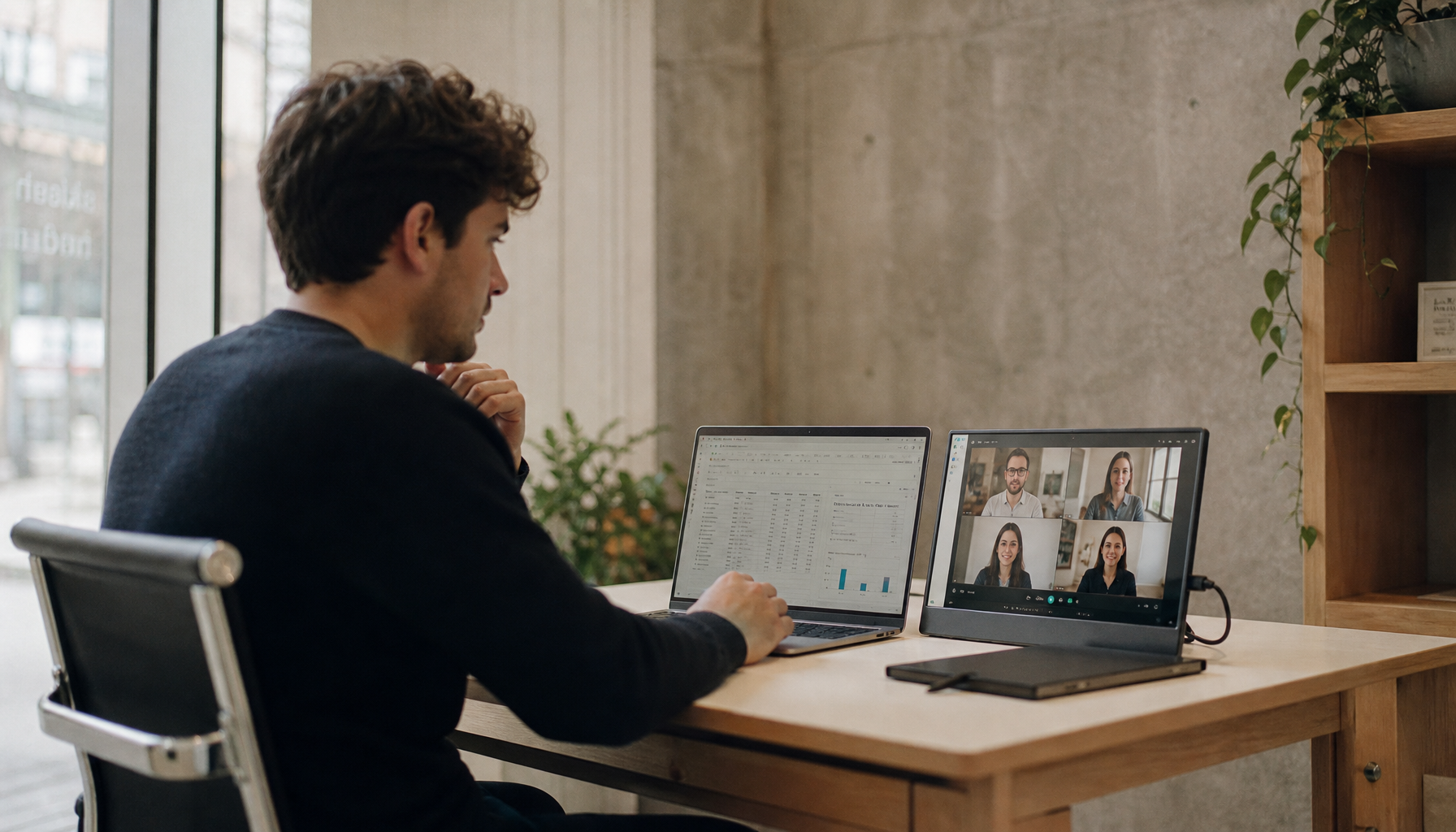
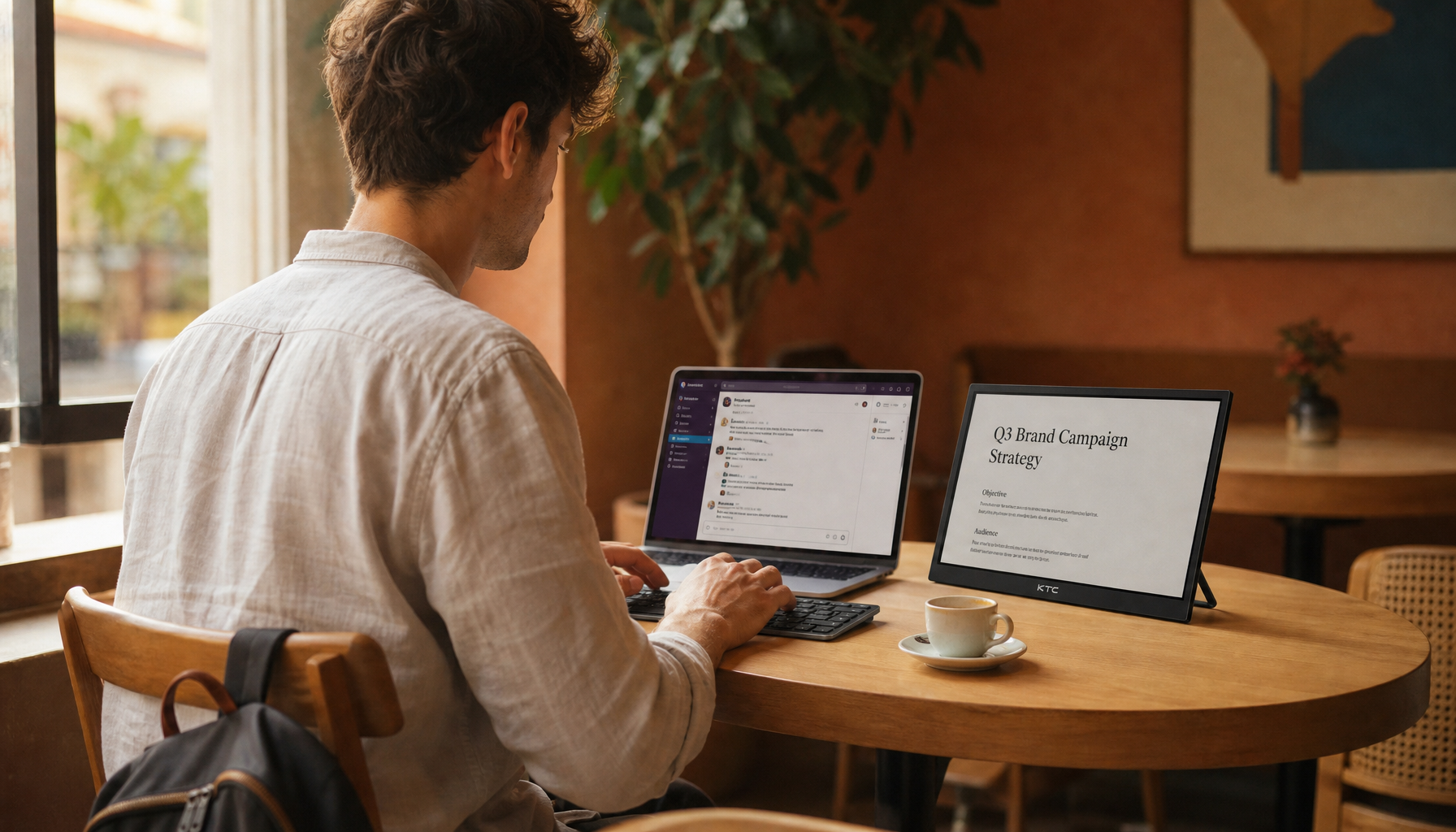
MegPad hybrid work makes sense when one screen has to do two jobs: stay useful at a desk and still move into a small meeting space without a full reset. For teams that split time between solo focus work and quick collaboration, a mobile display can reduce hardware duplication and make room changes less awkward. The best fit is usually a setup where movement, power access, and meeting flow are planned together, not added later.

Why One Mobile Display Fits Hybrid Teams
Hybrid work remains common and benefits from flexible workspace arrangements that support both remote and in-office collaboration. The main question is not whether a display is mobile, but whether that mobility actually removes friction. A rolling screen can make sense when the same team needs one display for a desk, a huddle, and a shared room during the same week. The practical value is in avoiding duplicated hardware and avoiding the "which room gets the good monitor?" problem.
That said, a mobile screen is not automatically the better choice. If a team rarely moves equipment, a fixed monitor can be simpler and cheaper. If the display needs to support remote meetings, the broader category of Mobile Touch Screen is the natural place to start browsing, because the category is built around portable, touch-enabled displays for work and home use.
A helpful rule of thumb is this: if the screen will move more than it sits still, the mobile workflow deserves real planning. If it will stay in one place most of the time, mobility may be a nice extra rather than the main reason to buy.
For most small teams, the first decision is not screen size. It is whether the room path, power outlet, and laptop connection are simple enough that people will actually move the display when needed.
Set Up the Workflow Around the Room
-
Start with the room that gets used most often. If the screen serves a weekly sync room and a daily desk, map the setup from the room that creates the most friction, not the one that looks best in a demo.
-
Keep the travel path clear. A rolling display is only convenient if it can move without weaving around chairs, loose cables, or tight corners. Even a small obstruction can turn a quick move into a nuisance.
-
Place power where the screen will spend the most time. The setup is easier when the charger, laptop cable, and any casting device are close to the screen's normal stopping point instead of stored across the room.
-
Build the cable routine before the first meeting. Teams often lose time not because the screen is hard to roll, but because HDMI, USB-C, and charging cables are not routed in a repeatable way.
-
End each day with a reset. A good mobile workflow is one that can be returned to a stable parking position, recharged, and ready for the next use without a scavenger hunt.
The planning logic here is simple: if a display is meant to support both desk work and meetings, the room should be designed around repeated movement. Smart Display for Home Office and Lifestyle: Multi-Room Setup Guide is a useful follow-up if you want more room-positioning ideas for multi-space use.

Choose the Right MegPad Model
| Model | Screen Size | Resolution | Battery | Best Fit | Workflow Note |
|---|---|---|---|---|---|
| KTC MEGAPAD 27" FHD Android 14 Google EDLA Smart Touch Monitor with 9500mAh Battery | 27-inch | FHD | 9500mAh | Lighter desk-to-meeting use | Better when portability and video calls matter more than extra screen sharpness. |
| KTC MEGAPAD 32" 4K Android 14 Google EDLA Smart Touch Monitor with 8550mAh Battery | 31.5-inch | 4K | 8550mAh | Shared-room collaboration | Better when the team wants a larger collaborative canvas and a more room-present screen. |
| KTC MEGAPAD 32" 4K Android 13 Google EDLA Smart Touch Monitor with 9500mAh Battery | 32-inch | 4K | 9500mAh | Meeting-room-first use | Better when the workflow emphasizes shared viewing and app-based collaboration. |
The 27-inch model is the more restrained choice. Its FHD resolution, wheels, 9500mAh battery, and 8MP camera fit a lighter collaboration pattern, especially when the screen will move often and the main use is video calls or short shared sessions.
The 32-inch models shift the decision toward room use. Their 4K panels, touch input, Android builds, and rolling stands are more compelling when the display is expected to stay in a shared space longer and serve as the center of a small team meeting.
One practical decision sentence is worth keeping in mind: if the display must feel like a meeting-room tool first, choose the 32-inch class; if it needs to move often and still handle daily desk work, the 27-inch class is usually easier to live with.
For readers who want a broader browsing path after comparing the two models, the Smart Monitor category is the cleaner next stop for checking adjacent options.
Build a Better Collaboration Routine
Focus Work at the Desk
For solo work, the main goal is comfort and quick continuity. The display should sit at a usable angle, reconnect quickly, and return to the same apps without making the desk feel like a temporary command center. That matters because hybrid teams lose time when a "mobile" screen turns into a setup project every morning.
The 32-inch MegPad options are useful here when a larger canvas helps with document review, side-by-side tabs, or a shared app dashboard. The 27-inch model is easier to justify if the desk use is secondary and the real value comes from moving into meetings later.
Quick Team Syncs and Whiteboarding
For small syncs, touch input changes the feel of the meeting more than a spec sheet does. It lets people interact with content directly, which is helpful when a group is standing close to the screen and the meeting is moving quickly. In plain terms, touch matters most when the display is acting like a shared tabletop rather than a passive TV.
That said, touch alone does not solve room friction. The screen still needs a clear place to roll, enough space to stand around, and a cable path that does not slow people down. In a real hybrid room, the workflow should feel faster than dragging a monitor from desk to desk.
Video Calls and Shared Review Sessions
Video calls are where the model differences become more visible. The 27-inch unit includes an 8MP camera and is shaped for lighter portable use, which makes sense when calls are frequent and the room is not being used for a permanent display. The 32-inch units are more room-centered, and their built-in Android and EDLA support make them better suited to app-based collaboration when the meeting stack fits the device.
The important boundary is compatibility. Verify the exact apps and meeting flow your team uses, because smart-display behavior can vary by app and network. If the team depends on one specific conferencing stack, the question is not only "does it run Android?" but "does it behave the way we need in our room?"
End-Of-Day Reset and Storage
Hybrid setups succeed when the screen is easy to close out. If the team has to disconnect multiple cables, hunt for charging access, or rearrange the room every night, the convenience advantage disappears. A repeatable reset routine keeps the display from becoming shared clutter.
This is also where The 2026 Smart Home Hub Blueprint: Mastering the Rolling Display Ecosystem can help if you want a broader view of how rolling display setups fit into a larger workspace flow.
Watch for Setup Limits
- Cable clutter can slow room changes if the display does not have a simple path to power and connected devices.
- Battery behavior varies with brightness, casting, and app use, so published runtime should be treated as a ceiling, not a promise.
- Touch and wireless casting help only when the app, network, and room layout support them.
- Stand adjustment and storage space should be checked before the team commits to a model or room plan.
- If the display will spend most of its life in one place, the mobility premium may not be worth it.
A useful not-a-fit filter is this: if your team cannot keep power, storage, and cables organized, the mobile screen will feel less flexible than the fixed monitor it was supposed to replace. In those cases, a simpler desk-first display may be the better buy.
Hybrid Use Questions
FAQs
Q1. How Does a MegPad Help a Hybrid Team Share One Display Across Spaces?
A MegPad helps most when one display has to move between solo work, small meetings, and occasional room-to-room use without creating duplicate setups. The main benefit is workflow flexibility, not novelty. It is most useful when the team wants one screen to serve both personal work and collaborative moments.
Q2. What Size MegPad Works Best for a Small Conference Room?
For a small conference room, the 32-inch options are usually the better fit because they give the room a more shared, meeting-friendly presence. The 27-inch model makes more sense when the screen moves often, the room is tight, or the use case leans more toward portable video calls than group viewing.
Q3. Can a MegPad Replace a Traditional Monitor for Daily Desk Work?
It can, but only when mobility and touch are part of the value. If the desk is permanent and ergonomic consistency matters more than movement, a fixed monitor may be easier to live with. The right answer depends on whether the screen is mainly a desk tool, a meeting tool, or both.
Q4. How Should Teams Manage Cables and Power When Moving the Screen?
Keep power access, charging, and laptop connections mapped before the first regular use. The best setup is one where cables are long enough to move with the display but not so loose that they become a snag. Teams should avoid moving the screen while it is awkwardly connected.
Q5. Can Hybrid Teams Use the Display for Video Calls and App-Based Collaboration?
Yes, but it is smart to verify the exact meeting apps and network conditions first. The product facts support video-call use and app-based collaboration, but real-world behavior still depends on the team's conferencing stack, Wi-Fi quality, and how the room is arranged.
Make the Workflow Fit the Room
MegPad hybrid work succeeds when teams verify three practical checks before committing: clear rolling paths between desk and meeting zones, reliable power and cable access at each stopping point, and app compatibility for the exact conferencing tools in use. The 27-inch model suits frequent moves and video calls; the 32-inch models suit longer shared-room sessions. Conference rooms and flex spaces should be arranged so all participants can see shared content and each other clearly during hybrid meetings. Cable management and power access should be planned before moving equipment between workspaces to avoid delays. When these elements align, the single display reduces friction instead of adding it.