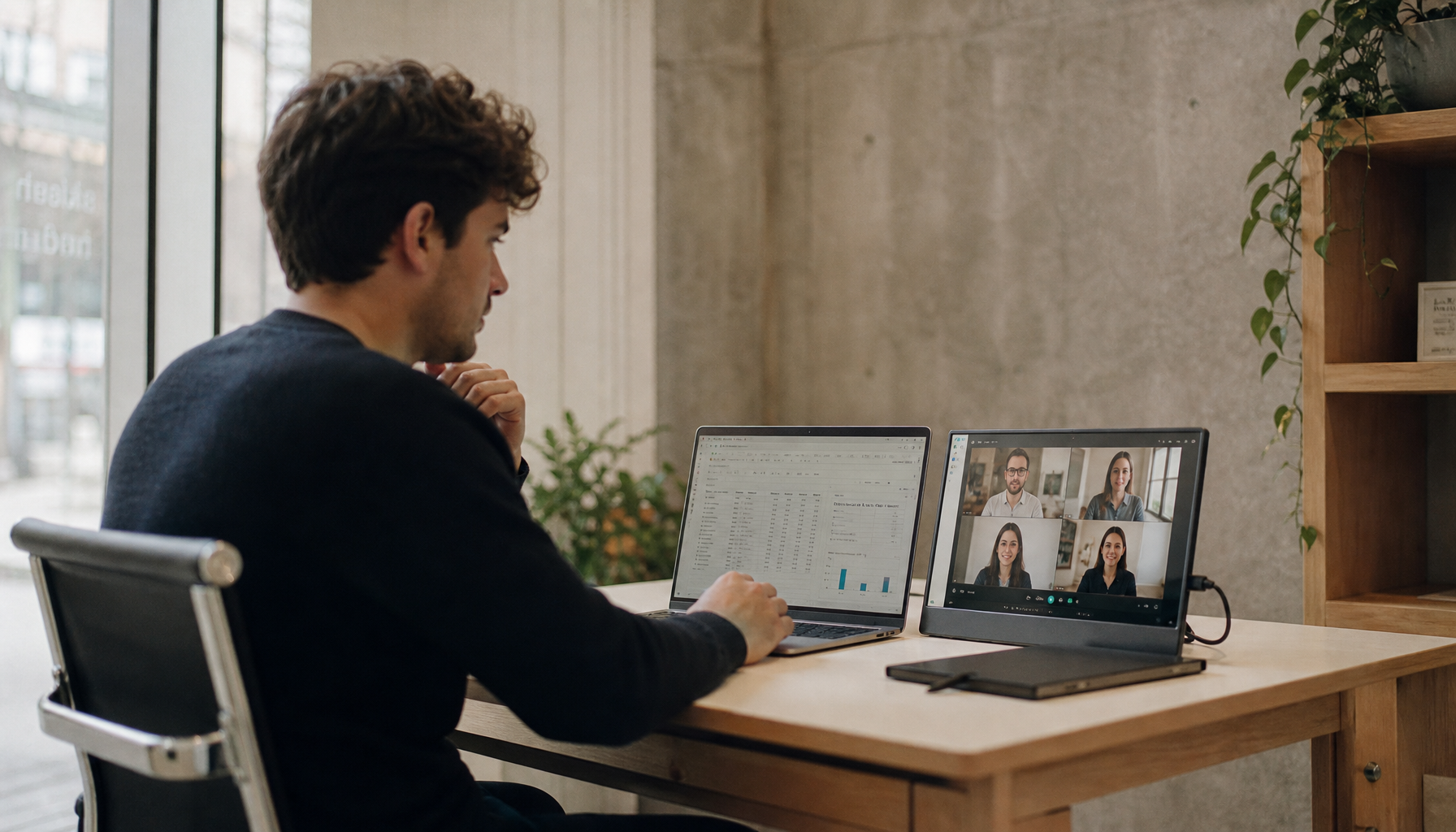
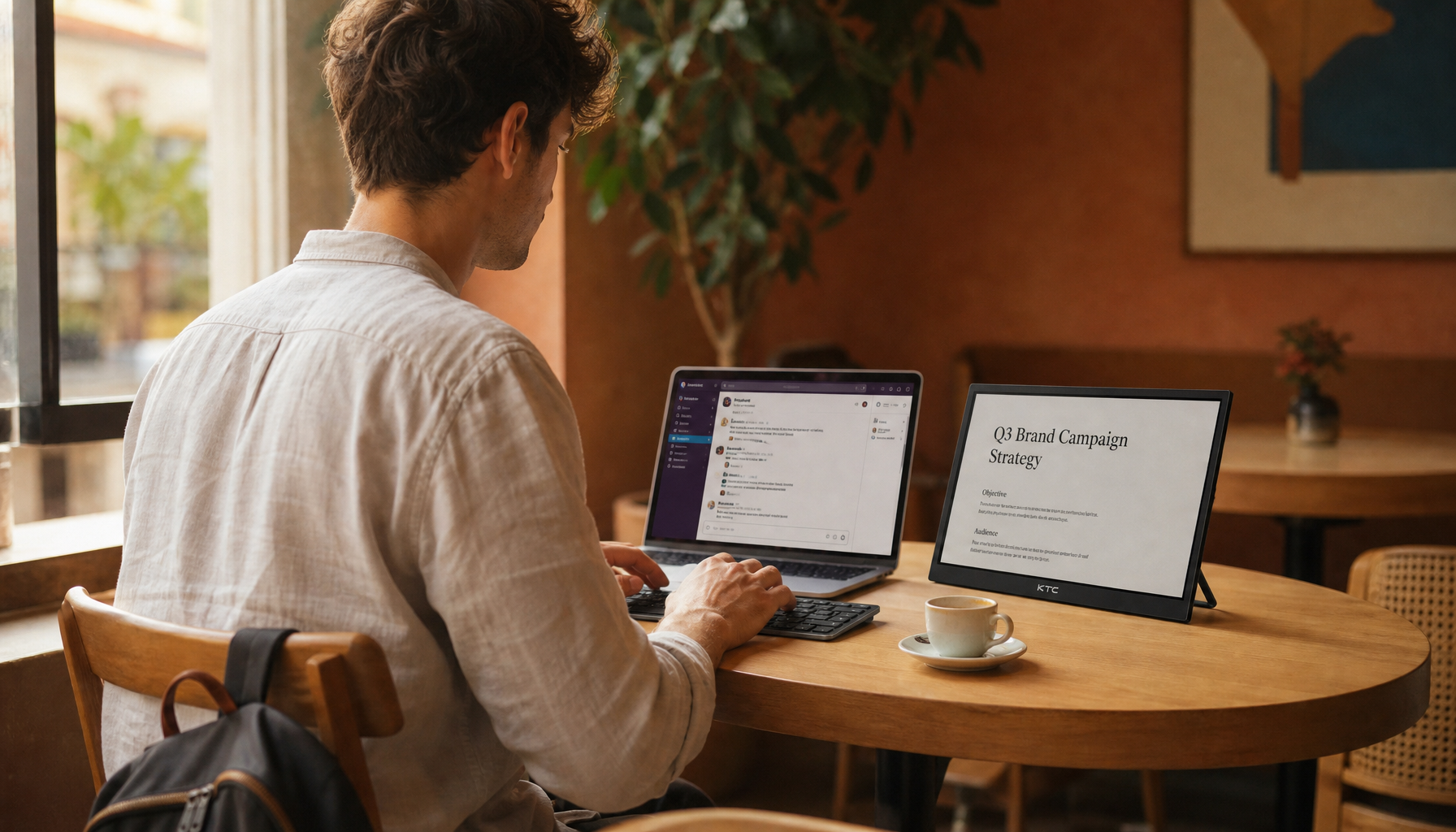
A USB-C KVM monitor works best on a hybrid desk when you treat the laptop and gaming PC as two different signal paths, not one universal cable path. For the laptop, USB-C can be the convenience cable if both devices support the right video and charging behavior; for the gaming PC, direct DisplayPort or HDMI is usually the safer choice for keeping refresh rate steady. How USB-C Docking Monitors Make Hybrid Work Laptop-to-Desktop Setups Easier

What a USB-C KVM Monitor Actually Solves
The real problem is not just switching inputs. It is trying to make one screen feel convenient for work and still feel fast for games. On a USB-C KVM monitor, the laptop side can handle display, charging, and sometimes peripherals, while the gaming PC can stay on a direct video cable that protects performance.
That split matters because a clean desk setup is only useful if it still behaves the way you expect after you switch sources. If you want one cable for the work laptop, that can be reasonable. If you want the gaming PC to keep every bit of its refresh-rate headroom, that path usually should stay separate.
The featured KTC OLED 27" 2K 240Hz/0.03ms USB-C Gaming Monitor | G27P6 fits this kind of desk as a dual-input monitor, not as a promise that every device will behave the same way on every port.
Check the Ports Before You Buy
Start with the ports, because most hybrid desk disappointment comes from assuming USB-C does more than the connected devices actually support. USB-C can carry video, data, and power only when the monitor and the laptop both support the needed mode, and that is why DisplayPort Alternate Mode over USB-C is worth checking before you buy. USB Power Delivery is a negotiated charging standard, so charging is separate from video behavior even when the same cable does both jobs.
For MacBook users, Apple says compatible Apple Silicon models can support high refresh rates over USB-C or Thunderbolt with the right cable, so USB-C is not automatically a low-performance path for laptops. Apple's high refresh rate guidance for Mac is the best quick check if you are trying to confirm that a Mac can stay on one cable during the workday.
The gaming PC side is different. In real use, DisplayPort or HDMI is usually the safer route because it keeps the signal chain simpler and makes it easier to preserve the refresh rate your monitor supports. A wired desktop path is also less likely to get muddied by docks, splitters, or adapters.
KVM routing is about more than video, too. It usually controls keyboard, mouse, and sometimes USB accessories. If you plan to use a wireless dongle, keep it in mind as a separate compatibility check, because USB 3.0 interference near wireless receivers can cause lag or stuttering on 2.4GHz peripherals.
Decision sentence: If your laptop supports USB-C video and charging, use it as the convenience path; if your gaming PC is the performance source, keep it on direct DP or HDMI.
Decision sentence: If you rely on a wireless mouse or keyboard, do not place the receiver right next to noisy USB 3.0 or KVM wiring unless you have tested it first.
USB-C Video and Power Basics
The phrase "one cable" only makes sense if the monitor and laptop both support the same feature set. That is why USB-C on a hybrid desk is a compatibility check, not a guarantee. A monitor may accept USB-C display input, but the laptop still has to output video over that port, and the charging wattage still has to match what the laptop expects.
If you want the cleanest laptop setup, the safest habit is to verify the port spec first and then treat charging as a separate question. That keeps you from buying a monitor that looks perfect on paper but falls short once the laptop is connected.
Gaming PC Inputs That Preserve Refresh Rate
For the desktop, the goal is not cable minimalism. The goal is keeping the refresh rate stable. That usually means connecting the gaming PC directly to DisplayPort or HDMI on the monitor instead of routing it through a hub or dock chain.
That advice matters more once you move above casual desktop use. If you care about 144Hz-plus gaming, a direct path is the lowest-risk choice because it removes extra variables before you start troubleshooting bandwidth or signal issues.
KVM and Peripheral Routing
A monitor KVM is handy because it lets you share peripherals across computers, but the video input and the USB upstream path are not always the same thing. That means the keyboard and mouse may switch cleanly while the actual display signal still comes from a different cable.
If the wireless receiver behaves strangely, test it separately from the video path. In some setups, moving the receiver away from USB 3.0 traffic solves the problem faster than changing the monitor settings.
Cable Quality and Signal Stability
If a monitor is not showing the refresh rate you expected, the cable is one of the first things to check. The most useful troubleshooting order is direct connection first, then another port, then another cable, and only then extra hardware like hubs or adapters.
That approach saves time because it tells you whether the problem is the source device, the monitor input, or the cable chain. It also keeps you from blaming the monitor for a setup problem that started somewhere else.
Map the Desk Wiring in Two Common Scenarios
A good USB-C KVM monitor setup usually comes down to a simple rule: let the laptop take the convenience path and let the gaming PC take the performance path. How USB-C Docking Monitors Make Hybrid Work Laptop-to-Desktop Setups Easier is useful background if you want the laptop side to feel more like a docked workstation, while software vs hardware workstation control helps if you are deciding how much switching should happen in hardware versus software.
- Identify the source device and the port it actually supports. If the laptop supports USB-C display output, start there. If the gaming PC has a strong DisplayPort output, use that as the first test path.
- Connect the laptop with one USB-C cable when the monitor and laptop both support video and charging over that path.
- Connect the gaming PC directly to the best verified video input, usually DisplayPort, if high refresh matters.
- Test input switching and peripherals before adding docks, hubs, or adapters. If something fails, simplify the chain before changing settings.
For this kind of desk, the monitor's own wiring matters because its signal chain should be easy to isolate. That is why the product page for the G27P6 hybrid monitor matters as a reference point, especially if you want a setup that can move between work and gaming without rewriting the whole desk.

Decision sentence: If your first connection is not stable, do not add a dock yet; get one direct cable working first.
Decision sentence: If the laptop works on USB-C but the gaming PC loses smoothness on that path, split the sources instead of forcing one universal route.
Where Refresh Rate Gets Limited
Refresh-rate problems often look like a monitor issue, but the actual bottleneck is usually the chain in front of the monitor. Resolution and refresh rate are separate limits, which means a setup can support the right resolution but still fail to expose the higher refresh option.
The most common causes are a dock or adapter in the middle, a cable that cannot handle the signal cleanly, or a port that is not the best choice for that source. A certified cable check is useful here because high-bandwidth display cable guidance often solves the "missing refresh rate" problem faster than changing monitor settings.
| Likely bottleneck | What it usually looks like | Check first |
|---|---|---|
| USB-C laptop path | Video works, but the refresh option is lower than expected | Verify USB-C video support, then test a direct cable |
| Gaming PC on dock or adapter | The monitor works, but smoothness drops | Bypass the dock and connect directly to DP or HDMI |
| Cable quality | Flicker, black screens, or unstable high refresh | Swap in a certified cable |
| Wireless receiver near USB 3.0 | Mouse or keyboard stutter, even if video is fine | Move the dongle away from USB 3.0/KVM wiring |
If you are shopping from a broader set of high-refresh displays, the Gaming Monitor collection is the cleaner browsing path than guessing from a title alone.
Decision sentence: When a high refresh mode does not show up, assume the cable or port path is the issue before assuming the panel is the problem.
Decision sentence: When the gaming PC is the source, a direct DP or HDMI link is usually the best first diagnostic step.
How the Product Fits a Hybrid Desk
The KTC OLED 27" 2K 240Hz/0.03ms USB-C Gaming Monitor | G27P6 is a straightforward fit for buyers who want one desk screen to do both jobs without making the setup complicated. The verified specs that matter here are the 2560×1440 panel, 240Hz refresh rate, 0.03ms GTG response time, and 65W USB-C charging while the monitor is in use.
For laptop work, that means you can keep the desk cleaner if the laptop supports USB-C video and power in the first place. For gaming, it means the monitor still has the speed and input flexibility to handle a separate PC connection without turning the laptop path into a compromise for everything else.
The port mix is what makes the hybrid story believable: 2× HDMI 2.0, 1× DP 1.4, 1× DP Alt Mode, and 2× USB 3.0. That does not mean every source should use every port. It means the monitor can support a split-path setup where the laptop and gaming PC each get the route that makes the most sense.
If you want a one-screen desk that works for work sessions and high-refresh gaming, this is the kind of monitor to compare carefully. If you want a more office-first screen, or you do not need the gaming side at all, it is probably more monitor than you need.
Build Your Final Buy Checklist
Before you buy a USB-C KVM monitor for a hybrid desk, run this quick check:
- Confirm your laptop supports USB-C video output, not just USB-C charging.
- Confirm the charging wattage is enough for your laptop, or be ready to keep the charger nearby.
- Confirm your gaming PC can use a direct DP or HDMI input for the refresh rate you want.
- Confirm your keyboard, mouse, and any wireless receiver will behave well near the monitor's USB path.
- Confirm your cable lengths match the desk layout so you do not end up stretching adapters across the desk.
If those checks line up, the setup is usually worth it. If they do not, keep the laptop on USB-C for convenience and leave the gaming PC on a direct cable path instead of trying to force one cable to do everything.
Frequently Asked Questions
Can a USB-C KVM Monitor Charge My Laptop and Run a Second Computer at the Same Time?
It can, but only when the monitor and both computers support the needed video, power, and input paths. The safest move is to verify the laptop's USB-C video support and then treat the gaming PC as a separate direct-input connection.
What Usually Causes Refresh Rate to Drop in a Hybrid Desk Setup?
The usual causes are the wrong input path, a dock or adapter in the chain, a cable that cannot carry the signal cleanly, or a source device that does not support the target mode. In practice, direct connection testing narrows it down fastest.
How Do I Tell If My MacBook or Laptop Supports USB-C Video?
Check the laptop's port specs for USB-C video support or DisplayPort Alt Mode, then confirm charging separately if you want one-cable convenience. For Apple Silicon MacBooks, Apple's display guidance is the fastest reliable reference.
Why Does My Mouse or Keyboard Act Weird After Switching Inputs?
That is usually a KVM, receiver placement, or USB-path issue rather than a video issue. Test the peripherals with a wired connection first, and keep wireless receivers away from busy USB 3.0 traffic when possible.
Can I Use One Cable for the Laptop and a Different Cable for Gaming?
Yes, and that is often the most practical hybrid-desk setup. USB-C can serve the laptop, while the gaming PC uses the port that preserves the refresh rate you care about.
Final Takeaway
A USB-C KVM monitor is most useful when you split the job by source: USB-C for the laptop if it supports the full path, and direct DisplayPort or HDMI for the gaming PC if refresh rate matters. That keeps the desk clean without turning convenience into a performance tradeoff. If you want a balanced hybrid option, compare the G27P6 against your laptop's USB-C support and your PC's direct video output before you buy.