



Use native resolution for final judgment, lighter viewport modes for active modeling, and a separate preview preset that lowers render scale, samples, and heavy visual effects.
Start With Native Resolution and Sensible Scaling
For modeling accuracy, keep your monitor at its native resolution whenever possible. LCD panels look sharpest when the display setting matches the panel’s fixed pixel grid, and native resolution avoids the blur that can come from interpolation.
In your operating system, choose the resolution marked Recommended and adjust UI scale separately if menus or toolbars feel too small. The display scale setting changes text and app size without forcing a lower-resolution image.
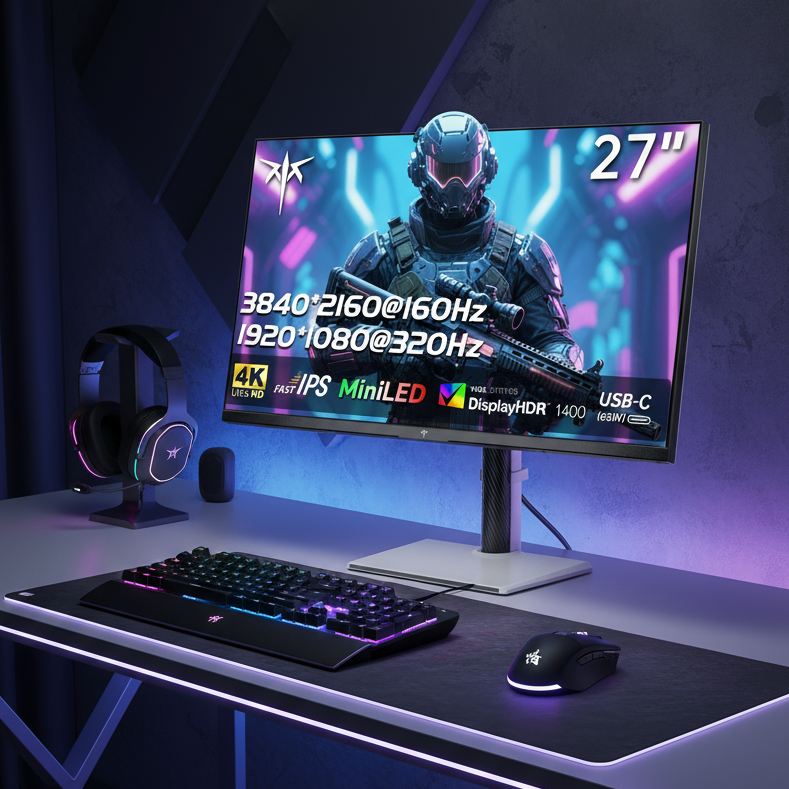
For a 4K monitor, this means staying at 3,840 x 2,160 for detail checks, UV work, texture inspection, and client previews. If viewport performance drops during heavy modeling, reduce the application viewport quality before lowering the entire operating system resolution.

Use a Fast Viewport for Modeling
Active modeling rewards responsiveness more than visual polish. Wireframe, solid, or simplified shaded modes reduce redraw load, making orbiting, zooming, panning, and selection feel more immediate.
CAD and 3D tools often benefit from hardware acceleration because the GPU handles more of the redraw work. Display tuning can improve slow navigation, and CAD-focused advice notes that hardware acceleration can help model rotation and panning when drivers and hardware support it.
A practical modeling preset keeps native monitor resolution with recommended OS scaling, uses solid or simple shaded viewport modes for editing geometry, and turns off shadows, ambient occlusion, transparency, and high-quality textures unless they are needed. Hide or freeze non-working model sections, and use current GPU drivers for stability. This keeps the screen sharp while reducing what the software must redraw every time you move the model.

Build a Separate Rendering Preview Preset
Rendering preview is where accuracy starts to matter again, but it still should not behave like final output. Use lower resolution, adaptive sampling, denoising, and controlled lighting previews to catch material, exposure, and composition problems quickly.
A strong preview preset is usually 25% to 50% of final output resolution. If your final render is 1,920 x 1,080, a 50% preview is 960 x 540, which is only one quarter of the pixel count. That is a major speed gain while still showing framing, color balance, and lighting direction.

For presentation work, define the output target before tuning settings. Digital decks often use 1,920 x 1,080, while 4K displays need 3,840 x 2,160; render teams should choose settings based on the output target, not just what the workstation can brute-force.
Preview renders can hide fine texture issues, so return to native-resolution checks before approving materials, labels, edges, and small surface details.
Tune for Color, Motion, and Interaction
Color settings matter because rendering preview is a decision tool. Use a calibrated display mode, disable eye-comfort color shifts during review, and keep brightness consistent across sessions.
For immersive previews, responsiveness is part of visual quality. Real-time viewport and web-based previews should stay within a tight frame budget; at 60 FPS, the practical rendering budget is about 10 ms per frame, rendering performance guidance.
For animation, walkthroughs, and real-time previews, prioritize smooth motion over ultra-heavy effects. Reduce viewport texture size, simplify non-focal geometry, and preview key frames before sending a full sequence. Cloud rendering workflows often use scout frames, such as first, middle, and last frames, to catch mistakes before committing time to a full job.

The Best Balanced Setup
The optimal display setup is a two-mode workflow: performance mode for modeling and accuracy mode for preview. Keep the monitor sharp, make the viewport light, and reserve full-quality rendering settings for final checks.
For most creators, the reliable baseline is native resolution, recommended OS scaling, GPU acceleration on, simplified modeling visuals, 50% preview renders, calibrated color, and final review at 100% output scale. That combination protects speed while keeping the screen trustworthy enough for modeling decisions and render approval.