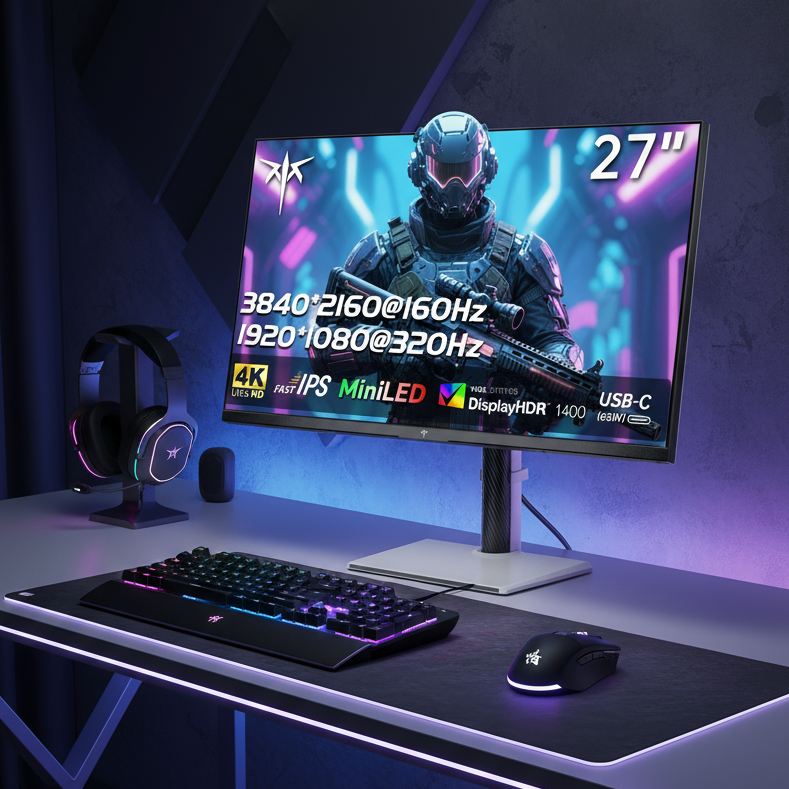


A 32-inch 4K 240Hz OLED strikes an exceptional balance for serious sim racers in 2026. It delivers roughly 140 PPI for crisp dashboard telemetry and apex markers at typical cockpit distances while its near-instantaneous 0.03 ms pixel response virtually eliminates motion smear during high-speed cornering. This combination often outperforms ultrawide alternatives for closed-cockpit realism and provides clearer visual data than lower-refresh 4K panels or faster-refresh LCDs, provided your GPU can sustain the frame rate and you manage the manageable burn-in risk from static HUD elements.

The 140 PPI Advantage: Dashboard Legibility at 60cm
At cockpit viewing distances of 60–80 cm, pixel density directly affects how quickly you can read brake bias, fuel deltas, and distant track markers without scaling the UI. A 32-inch 4K panel reaches approximately 140 PPI, noticeably sharper than a typical 27-inch 1440p monitor at 109 PPI or many 34-inch ultrawides. This sharpness lets small telemetry numbers appear printed-page clear rather than slightly aliased, helping you resolve 150 m brake boards 20–30 m earlier on approach.
The practical result is reduced eye movement and lower cognitive load during long stints. You can mount the monitor closer behind the wheelbase for a more immersive field of view without the screen-door distraction that lower-density panels create on high-contrast curbs or white lines. As one detailed review of a comparable 32-inch 4K 240 Hz OLED notes, the higher PPI makes close-range cockpit use far more comfortable (https://monitornerds.com/aorus-fo32u2p-review-premium-32-inch-4k-240hz-oled-monitor-highly-recommended/).
Keep in mind that driving 4K at high frame rates roughly doubles the pixel load versus 1440p, so verify your GPU headroom before committing. For more on resolution trade-offs in competitive play, see our guide to 4K for Competitive Gaming: A Performance Advantage or Disadvantage?.
Motion Clarity: Why 0.03ms Beats High-Hz LCDs for Apex Tracking
Refresh rate (Hz) tells you how often the screen updates, but pixel response time (GtG) determines how cleanly each frame transitions. OLED panels reach roughly 0.03 ms GtG, which virtually eliminates the ghosting and smearing common on Fast IPS panels that average 3–5 ms in real-world conditions. The difference becomes obvious when you make rapid steering corrections: curb edges and apex markers stay sharp instead of trailing.
VESA ClearMR provides a more complete picture than GtG numbers alone. Top 240 Hz OLEDs typically land in the ClearMR 9000+ tier, indicating significantly less blur than even many 360 Hz LCDs. This clarity helps you hold tighter, more consistent lines because the visual data remains actionable frame after frame.
Why Response Time Matters More Than Raw Hz for Apex Tracking
This comparison highlights motion-clarity differences in high-speed steering: lower response time and higher ClearMR ratings reduce ghosting and smearing, helping the eye track the apex more cleanly frame to frame.
View chart data
| Category | GtG Response Time (ms) | Motion Clarity Tier |
|---|---|---|
| 240Hz OLED | 0.03 | 3.0 |
| 360Hz Fast IPS/LCD | 4.0 | 2.0 |
The official explanation of how 0.03 ms redefines monitor speed metrics confirms that OLED’s low persistence delivers clearer motion than raw refresh-rate numbers suggest (https://us.ktcplay.com/blogs/technology-hub/oled-response-time-paradigm-redefining-monitor-speed-metrics). For deeper background on why higher refresh rates alone do not eliminate blur, read What Is Sample-and-Hold Blur and Why Higher Refresh Rates Don’t Eliminate It?.

32-Inch 4K vs. Ultrawide: The FOV and Realism Tradeoff
Many sim racers assume ultrawide is automatically more immersive, yet the choice depends on your racing style and cockpit type. A 32-inch 16:9 4K panel supplies more vertical screen real estate and higher pixel density than most 34-inch or 49-inch ultrawides capped at 1440p vertically. For GT3, WRC, or NASCAR-style closed-cockpit cars, the extra height preserves a realistic view of the dashboard, steering wheel, and roofline while keeping small telemetry sharp.
Ultrawides excel at horizontal peripheral vision, which can feel more natural in open-wheel formulas where side awareness matters more than interior scale. However, the lower PPI on many ultrawide panels can make distant markers and fine HUD text less legible at the same seating distance. As the sim-racing FOV guide explains, 16:9 often maintains a more accurate 1:1 interior scale for cockpit-focused racing (https://mysimrig.nl/en/blog/simracing/sim-racing-fov-guide/).
If your rig mounts the monitor close (under 70 cm), the 32-inch 4K option usually fills your vertical field of view more naturally. For users exploring ultrawide options, our guide Should Your Next Gaming Monitor Be an Ultrawide? A Gamer's Guide outlines the broader trade-offs.
Cockpit Immersion: Ideal Viewing Distance and Setup
Positioning matters as much as panel choice. For a 32-inch screen in a single-monitor rig, 60–80 cm from your eyes typically balances a wide field of view with comfortable eye movement. Placing the monitor directly behind the wheelbase at this distance maximizes immersion without forcing excessive head or eye scanning.
At closer range the 140 PPI keeps pixels invisible even on bright track elements, preserving the sense of sitting inside the car. Sit too far and you lose the cockpit “boxed-in” feeling; sit too close without sufficient density and the pixel grid distracts. The sim racing monitor guide recommends this range for most dedicated cockpit builds (https://simracingcockpit.gg/gaming-monitors-guide/). Experiment within that window while keeping your seating posture realistic to the car you are driving.
Hardware Demands and Burn-in Mitigation for Sim Racers
Driving 4K at 240 Hz demands substantial GPU power and bandwidth. Modern high-end cards (RTX 4080 class or better) paired with DisplayPort 1.4 or 2.1 using Display Stream Compression are usually required to maintain full color depth and refresh rate without compromise. Lower-end hardware will force reduced settings or lower frame rates, negating much of the monitor’s advantage.
Static HUD elements in sim racing—telemetry overlays, track maps, brake bias indicators—raise legitimate burn-in concerns on OLED panels. The risk is real but manageable. Built-in features such as pixel shifting, logo luminance reduction, and effective thermal designs (including custom heatsinks on premium models) significantly lower the chance of permanent image retention when used consistently. Enable these protections, vary your session lengths, and use pixel-refresh cycles as recommended by the manufacturer.
When matching a monitor to your graphics card, consult How to Choose the Perfect Monitor to Match Your Graphics Card. The All-OLED Monitor collection contains models that already incorporate many of these safeguard technologies; verify the specific GPU and connection requirements for your rig before purchase.
Choosing the Right 32-Inch 4K 240Hz OLED Setup for Your Rig
Start by confirming your GPU can sustain 4K near 240 fps in your primary titles at acceptable settings. Closed-cockpit racers prioritizing dashboard realism and telemetry legibility usually benefit most from the 16:9 4K layout, while open-wheel drivers chasing maximum peripheral awareness may still prefer a high-quality ultrawide. Budget for a robust mounting arm that holds the monitor rigidly at 60–80 cm and plan to enable all factory OLED protections from day one.
If your current rig runs a high-end GPU and you race primarily in iRacing, Assetto Corsa Competizione, or similar titles where precise apex tracking and readable in-car data matter, a 32-inch 4K 240 Hz OLED is frequently the clearest upgrade path. Those with mid-range GPUs or heavy reliance on static overlays should either step down in resolution or invest extra time in burn-in monitoring routines. The decision ultimately hinges on whether your setup can feed the panel the frames it needs and whether your play style values vertical realism over horizontal stretch.
FAQs
Does 240Hz Make a Noticeable Difference in Sim Racing?
In sim racing, 240 Hz combined with OLED’s near-instant response improves motion clarity more than the refresh-rate number alone suggests. The smoother frame delivery and reduced smear help you maintain tighter lines through fast corners, but only if your GPU consistently delivers frames close to that ceiling. Below roughly 140–160 fps the perceptual gain shrinks, so pair the monitor with hardware that can sustain high frame rates in your chosen titles.
Is OLED Burn-in a Serious Risk for Sim Racing HUDs?
Static elements like telemetry bars and track maps do increase burn-in potential on OLED panels. However, modern monitors include pixel shifting, automatic logo dimming, and scheduled refresh cycles that greatly reduce the risk when used as directed. Treat burn-in as a manageable concern rather than a deal-breaker: enable every protection feature, avoid leaving the same static image on for hours daily, and run the built-in pixel cleaners periodically.
Should I Choose a 32-Inch 4K or an Ultrawide for Sim Racing?
Closed-cockpit racers (GT3, rally, NASCAR) usually prefer the 32-inch 16:9 4K layout for its superior vertical realism and higher pixel density, which keeps the dashboard and roofline in natural proportion. Open-wheel or formula-style drivers often favor ultrawides for the extra horizontal peripheral vision. Test both aspect ratios in your specific titles if possible; many drivers find the 4K option more readable for in-car data at typical cockpit distances.
What GPU Do I Need to Run 4K 240Hz in iRacing or Assetto Corsa?
Current high-end cards such as an RTX 4080 or 4090 are generally required to approach 200+ fps at 4K with high visual settings and full ray tracing where applicable. Expect to use Display Stream Compression over DisplayPort and may need to lower certain shadows or anti-aliasing settings to stay above 180 fps. Mid-range GPUs will force noticeable resolution or refresh-rate compromises that reduce the monitor’s value.
How Does Viewing Distance Affect 32-Inch OLED Performance in a Cockpit?
At 60–80 cm the 140 PPI of a 32-inch 4K OLED keeps every pixel invisible while filling a natural portion of your field of view. Closer than 50 cm the pixel grid can become noticeable on bright elements; farther than 90 cm you lose the immersive “in-car” scale and small HUD text becomes harder to read without leaning forward. Mount the screen directly behind the wheelbase for best results and adjust your seat so the monitor sits at eye level.
Can a 32-Inch 4K OLED Replace a Triple-Monitor Setup?
For many single-screen cockpit users it can, especially those who value dashboard legibility and motion clarity over panoramic peripheral vision. A well-positioned 32-inch 4K panel with proper FOV settings often feels more realistic in closed cars than stretched triples. However, dedicated triple-monitor users chasing maximum width will still prefer that configuration. The 32-inch OLED shines most as a premium single-monitor solution rather than a direct triple replacement.