Your USB-C monitor supports daisy-chaining only if it has the right video transport, a usable downstream output, and host support for MST or Thunderbolt. The quickest proof is to check for DisplayPort Alt Mode, DisplayPort Out or Thunderbolt Out, MST support, and enough bandwidth for your target resolution and refresh rate.
Is your desk already full of cables, yet your second monitor still refuses to light up from the first display? A correct USB-C daisy-chain check can save you from buying the wrong cable, hub, or monitor, and it can give you a clean one-cable laptop workstation when the hardware lines up. Here is what to verify on the monitor, laptop, cable, and settings menu before you spend money.
What Daisy-Chaining Means for USB-C Monitors
Daisy-chaining means your computer connects to the first monitor, and that monitor passes video to the next display. Instead of running two separate video cables from your laptop, you run one cable from the laptop to monitor one, then another cable from monitor one to monitor two.

The critical detail is that USB-C is only the connector shape. A USB-C port may carry charging, data, video, or all three, but the oval port alone proves nothing. USB-C can support DisplayPort over USB-C only when the device explicitly includes the right DisplayPort capability, which is why two monitors with identical-looking USB-C ports can behave completely differently.
For a productivity setup, the reward is real. A 14-inch laptop paired with two 27-inch displays can become a command center for spreadsheets, timelines, code, chat, and reference material without turning the desk into a cable nest. For gaming, streaming, or creative editing, the same concept helps keep the primary display path cleaner, although bandwidth limits become more important at high refresh rates and 4K.
The Four Compatibility Checks That Matter
Check the USB-C Input for DisplayPort Alt Mode or Thunderbolt
The first monitor must accept video from the computer through USB-C. Look for wording such as “USB-C with DisplayPort Alt Mode,” “DisplayPort over USB-C,” “Thunderbolt 3,” “Thunderbolt 4,” or “USB4 with display support.” If the spec sheet only says “USB-C charging” or “USB-C upstream,” do not assume it can receive a video signal.
This is where many setups fail. Not all USB-C cables or ports support the same capabilities, and the connector can hide major differences in speed, power, and display support. In practical terms, a cable that charges your laptop may still produce a black screen because it lacks the wiring or certification needed for video.
Look for a Real Downstream Video Output
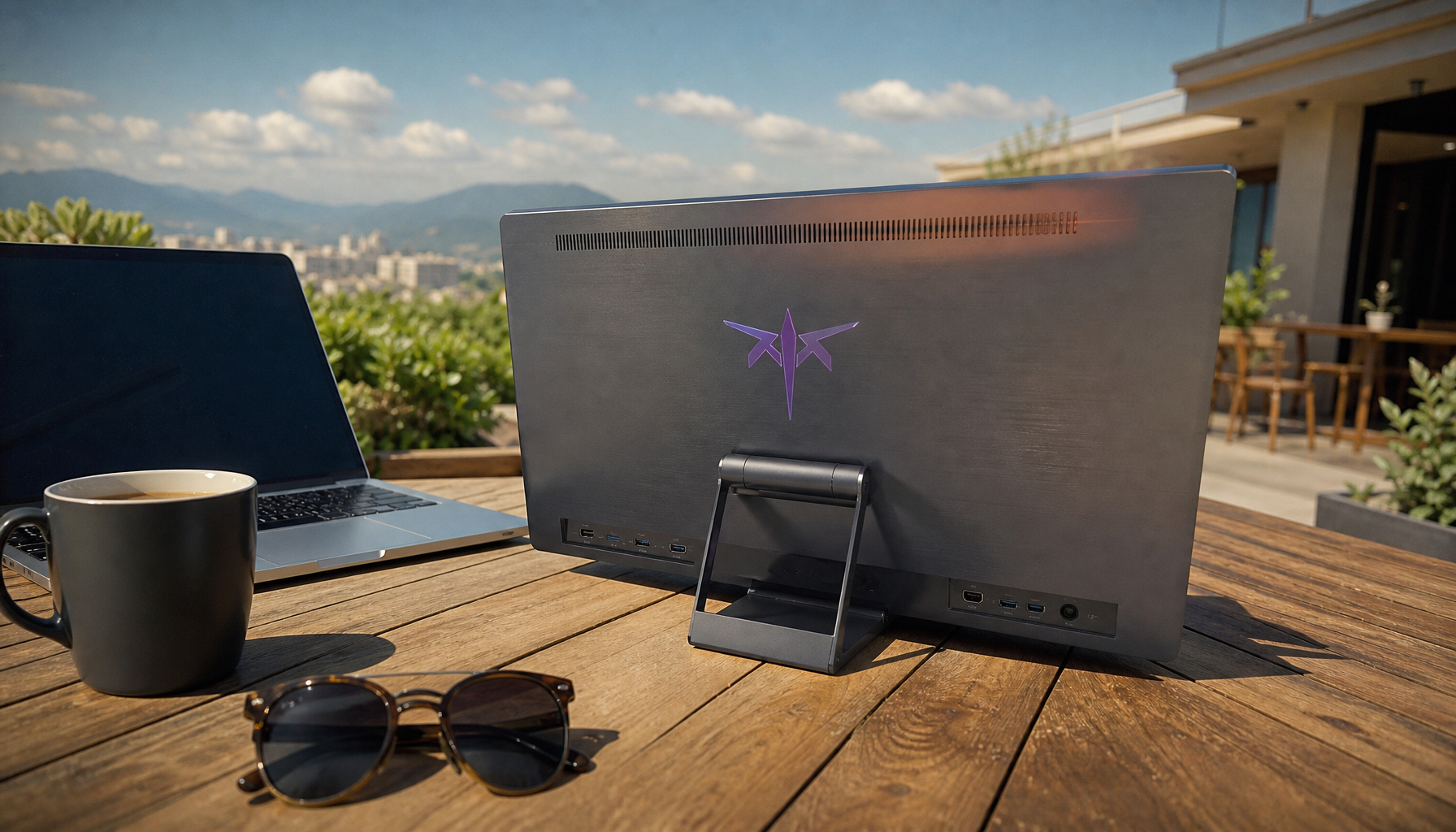
A daisy-chain-capable first monitor needs a way to send video onward. That usually means a DisplayPort Out port or a Thunderbolt Out port. A USB-C input alone is not enough, and an HDMI port on the monitor usually does not mean the monitor can pass a second display signal.
A reliable product page will call this out directly with terms such as “MST,” “daisy chain,” “DisplayPort out,” or “Thunderbolt daisy chain.” Monitor buying references such as daisy-chain monitor lists are useful because they focus on displays with the required ports rather than generic USB-C monitors.
Confirm MST or Thunderbolt Support on the Host
For DisplayPort-based daisy-chaining, your laptop or desktop graphics output must support Multi-Stream Transport, commonly called MST. MST lets one DisplayPort signal carry multiple independent display streams, so your operating system can extend the desktop across multiple screens instead of merely mirroring one image.
Thunderbolt works differently but serves a similar practical goal. A Thunderbolt chain can pass display and data through compatible devices, and it is often the cleaner route for premium workstations. Thunderbolt and USB-C capabilities vary by standard, so a Thunderbolt cable or port label carries more meaning than a plain USB-C logo.
Match Bandwidth to Resolution and Refresh Rate
Even when daisy-chaining is supported, bandwidth decides what the setup can actually drive. Two 1080p monitors at 60 Hz are far easier to run than two 4K monitors at 60 Hz, and high-refresh gaming panels raise the demand further. A competitive player trying to run a 144 Hz main display plus a second productivity panel should check bandwidth more carefully than an office user running two 60 Hz screens.
A simple rule works well: treat each added monitor as another claim on the same video pipeline. If the first screen is 4K at 60 Hz and the second is also 4K at 60 Hz, the chain needs a stronger DisplayPort, Thunderbolt, or USB4 implementation than a pair of 1080p office displays. USB-C can reach very different speeds depending on the underlying standard, so “USB-C monitor” is not a performance specification.
What You See in Specs |
What It Usually Means |
Daisy-Chain Confidence |
USB-C with charging only |
Power delivery, no confirmed video |
Low |
USB-C with DisplayPort Alt Mode |
Video input over USB-C |
Medium |
DisplayPort Out plus MST |
Can pass video to another monitor |
High |
Thunderbolt In and Thunderbolt Out |
Strong daisy-chain candidate |
High |
HDMI only |
Not true monitor daisy-chaining |
Low |
How to Verify It Before Buying
Start with the monitor’s official spec sheet, not just the marketplace title. Search the page for “MST,” “DisplayPort Out,” “DP Out,” “Thunderbolt Out,” “daisy chain,” and “DisplayPort Alt Mode.” If those words are missing, assume the monitor is not a daisy-chain hub until proven otherwise.
Marketplace search pages can help you discover candidates, but they are weak proof. USB-C daisy-chain monitor listings may include products that mention USB-C, docking, or multi-monitor use without confirming the exact downstream port and MST behavior. Treat those listings as a starting point, then verify against the manufacturer’s technical specifications.
Also check the laptop. A USB-C port on a thin notebook may support charging and data but no external display. A business laptop may support DisplayPort Alt Mode but not enough display streams. A workstation-class laptop with Thunderbolt 4 is more likely to support a cleaner multi-display setup, especially if you also need laptop charging and USB peripherals through the same cable.
How to Test a Monitor You Already Own
Connect the laptop to the first monitor using a full-featured USB-C, USB4, or Thunderbolt cable that supports video. Then connect the first monitor’s DisplayPort Out or Thunderbolt Out to the second monitor’s input. Open the monitor’s on-screen menu and enable MST or DisplayPort 1.2/1.4 mode if that option exists.
In your display settings, check whether both external monitors appear as separate screens. If they mirror each other, change the mode to extend the desktop. If the second display is missing, swap the downstream cable, confirm you used the output port on the first monitor rather than another input, and reduce resolution or refresh rate to test for a bandwidth ceiling.
On some computers, Thunderbolt daisy-chaining is typically the stronger path. DisplayPort MST behavior has historically been more limited for extended desktops on certain systems, so a setup that works on one laptop may not behave the same way on another. That is not necessarily a monitor defect; it can be a host-side support issue.
Pros and Cons of USB-C Daisy-Chaining
The biggest advantage is desk discipline. One cable can carry video, charging, and USB hub connectivity to the first monitor, while the second display hangs off the chain. For office productivity, that means fewer occupied laptop ports, easier docking, and a cleaner sit-stand desk.

The tradeoff is complexity. You must align the monitor, laptop, cable, graphics capability, firmware, and operating system behavior. USB-C hubs are often positioned as an alternative when MST is unavailable or when you need more ports, Ethernet, card readers, or a simpler laptop docking setup.
For gaming monitors, daisy-chaining is less universally attractive. High refresh rates, adaptive sync, HDR, and 4K resolution all consume bandwidth. A direct DisplayPort or HDMI connection to the gaming monitor may deliver more predictable performance, while the second display can use a dock or separate output for chat, monitoring, or streaming tools.
Cable Quality and Physical Reliability Matter
A daisy-chain setup is only as reliable as the weakest cable in the path. Use certified cables that explicitly support the required video standard, power level, and length. A short, well-rated cable is usually more dependable than a long generic charging cable, especially at 4K or high refresh rates.

There is also a mechanical side. USB-C is commonly associated with a 10,000 insertion-cycle durability rating, but real desks introduce angled pulls, side pressure, and daily movement. A practical takeaway USB-C durability discussions is to rely on testing and strain relief rather than assumptions about connector shape. If your laptop sits on a stand, route the cable so it does not tug sideways on the port.
When a Dock Is the Better Choice
Choose a dock when your monitor lacks DisplayPort Out, when your laptop does not support MST, or when you need Ethernet, multiple USB devices, audio, and charging in one hub. A dock can also be cleaner for mixed monitors, such as one 4K productivity display and one older HDMI display.

Choose daisy-chaining when both monitors support it, your laptop has the right output, and your priority is a lean display-first workstation. For many office users, a USB-C monitor with power delivery, DisplayPort Out, and a built-in USB hub is the highest-value setup because it turns the monitor into the docking point.
Quick FAQ
Can any USB-C monitor daisy-chain another display?
No. A USB-C monitor needs compatible video input and a downstream output such as DisplayPort Out or Thunderbolt Out. Plain USB-C charging or data ports do not prove daisy-chain support.
Does HDMI support daisy-chaining?
Not in the true monitor-to-monitor sense used by DisplayPort MST or Thunderbolt. If your setup is HDMI-only, use a dock, hub, or graphics output that can drive multiple displays independently.
Can I daisy-chain two 4K monitors?
Sometimes. The answer depends on DisplayPort, Thunderbolt, USB4, graphics hardware, cable quality, refresh rate, and monitor settings. Two 4K displays at 60 Hz demand much more bandwidth than two 1080p office monitors.
What is the fastest way to know before buying?
Look for three phrases in the spec sheet: “USB-C DisplayPort Alt Mode,” “MST,” and “DisplayPort Out” or “Thunderbolt Out.” If one of those is missing, ask the manufacturer before assuming the monitor can extend a second display.
A USB-C monitor is daisy-chain ready only when the whole chain is ready: host, port, cable, first monitor, downstream output, and bandwidth. Confirm those checks first, and the result is the kind of clean, powerful screen setup that makes a laptop feel like a full workstation.