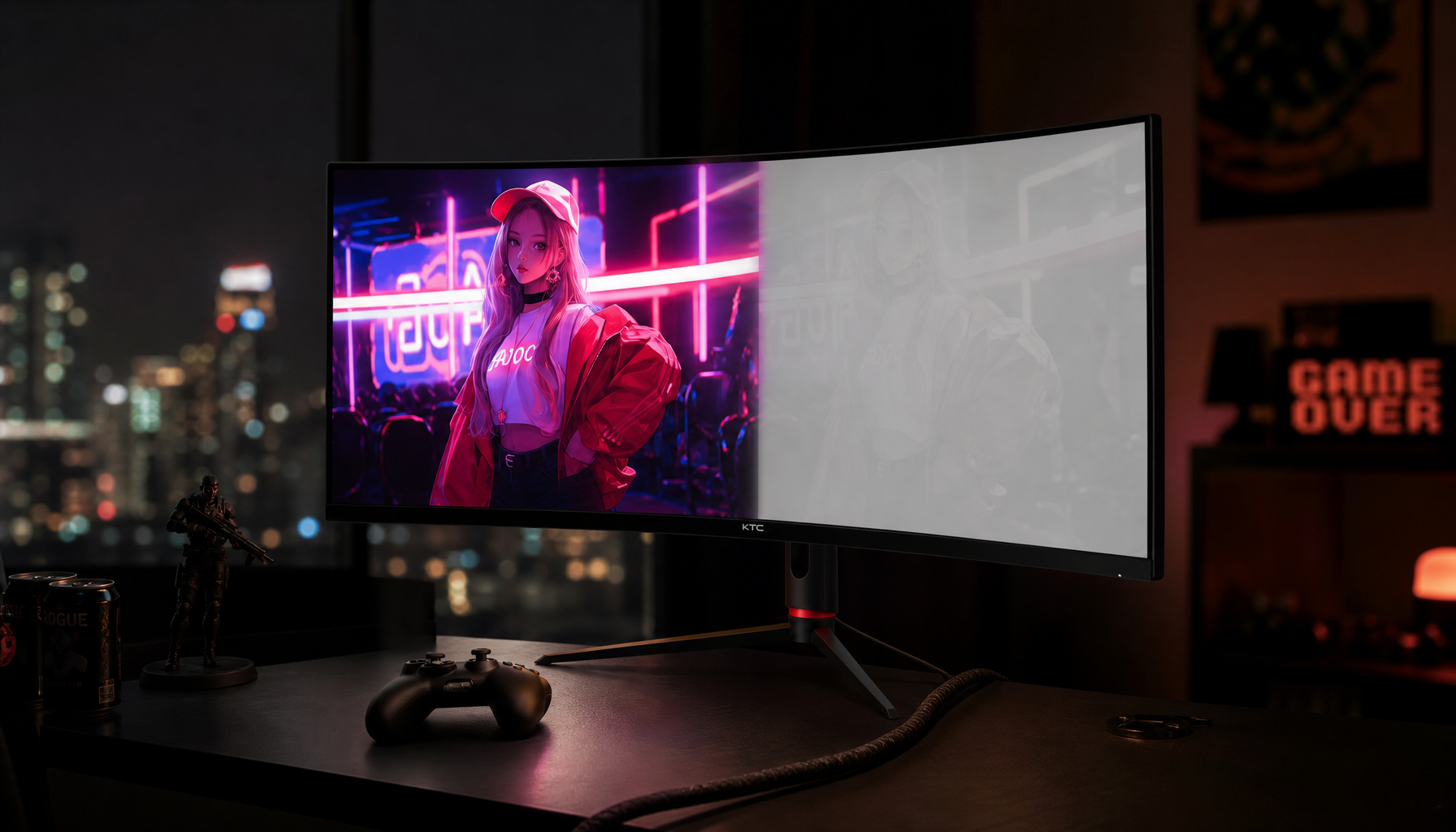
VA panels achieve higher contrast because they block more backlight in dark scenes, which gives gaming monitors and everyday displays deeper blacks than typical IPS panels.
If you have ever opened a dark game, movie, or black-themed desktop and thought the screen looked gray instead of black, you are seeing the contrast gap in real use. Lab comparisons on two 55-inch curved LCDs found VA leaked about 10 times less black light than IPS under the same bend. The rest of this guide shows why that happens, what it changes on real monitors, and when IPS is still the better buy.

The Core Reason VA Looks Darker
A VA panel starts in a normally black state, with its liquid-crystal molecules aligned vertically when no voltage is applied. That vertical posture blocks more of the backlight before it reaches the color filters. IPS works differently: its crystals rotate more in the plane of the panel, which helps keep color and brightness more stable from the side, but it usually lets more stray light through in dark states.
That structure is why native contrast ratio is typically much higher on VA. Many VA monitors land around 3,000:1 or better, while standard IPS displays often sit closer to 1,000:1 to 1,500:1. At the same 120-nit white level, a 3,000:1 panel is roughly 0.04 nits black, while a 1,000:1 panel is about 0.12 nits black. That is the difference between a black loading screen looking convincingly dark or looking like dark gray.
Parameter |
VA Monitor |
IPS Monitor |
What It Means in Practice |
Crystal behavior at rest |
Vertical, normally black |
Rotates in-plane |
VA blocks more backlight when the image should be dark |
Typical native contrast |
About 3,000:1 or higher |
About 1,000:1 to 1,500:1 |
VA usually shows deeper blacks and stronger image depth |
Black level at 120 nits white |
About 0.04 nits at 3,000:1 |
About 0.12 nits at 1,000:1 |
Dark scenes look richer on VA |
Viewing angle stability |
Good, but more shift off-center |
Better color consistency off-axis |
IPS is safer for shared viewing and creator work |
Motion behavior |
Can smear in dark transitions |
Usually cleaner |
IPS often feels sharper in fast shooters |
Best fit |
Dark-room gaming, movies, ultrawide immersion |
Mixed use, editing, competitive play |
Choose based on scene type, not marketing alone |
What Higher Contrast Changes on a Real Gaming Monitor
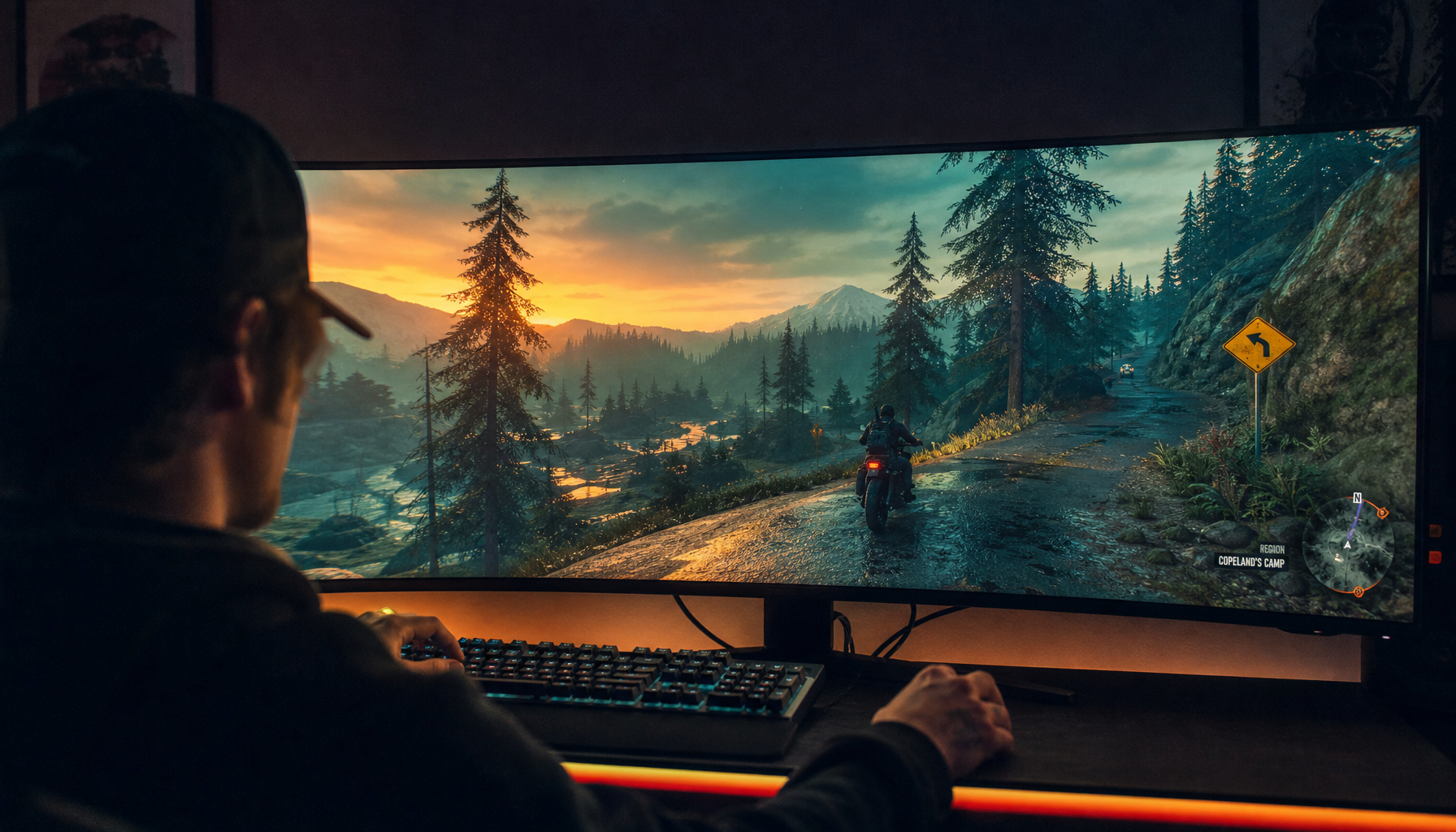
The main advantage of VA panels is not just a better spec sheet number. On a gaming monitor, higher contrast makes shadow-heavy scenes easier to read, black bars less distracting, and bright HUD elements stand out more cleanly against a dark background. That is especially noticeable in horror games, space games, story-driven RPGs, and late-night play with the room lights low.
A dark-room VA setup also tends to look less washed out on desktop tasks that use black or charcoal themes. If you spend hours in a dark UI, edit video in a dim office, or use an ultrawide for both games and streaming, deeper blacks can make the whole display feel more solid and less hazy. IPS still looks good, but its lower native contrast usually shows up fastest when the screen is supposed to look dark.
For buyers comparing high-refresh-rate displays, VA’s strong black performance often gives more visible benefit than a small bump in listed brightness. A monitor that reaches a similar peak white but holds a lower black floor will usually look punchier in real content. That is why many VA gaming monitors feel more cinematic even before HDR is turned on.
Why It Matters Even More on Curved and Ultrawide Displays
A curved LCD study is especially useful for monitor buyers because it measured black luminance at nine points on two 55-inch panels, one VA and one IPS. Under the same curvature conditions, the VA panel showed about 10 times lower black light leakage than the IPS panel. The paper also noted that bending stress around the liquid-crystal cell gap can increase black leakage, so panel mode matters even more once curvature enters the picture.
That matters for curved gaming monitors and ultrawides because those designs put more visual weight on edge uniformity and dark-scene consistency. On a 32-inch 1000R curved gaming monitor such as the a 32-inch 2K 240Hz 1000R curved gaming monitor, VA’s deeper blacks are often easier to notice than they are on an IPS alternative. A wider screen makes edge glow, uneven blacks, and low-level haze easier to notice when you are sitting centered and filling more of your field of view. If your priority is immersion on a 34-inch ultrawide or a large curved desktop monitor, VA’s contrast advantage is often easier to appreciate than it is on a smaller flat office display.

The tradeoff is that not every curved VA monitor is automatically better. Backlight quality, panel tuning, and uniformity still vary from model to model. But when two LCD monitors are otherwise in the same class, the VA panel usually starts with a stronger foundation for dark-scene performance.
Better Contrast Helps HDR, but It Is Not the Same as Great HDR
A higher native contrast ratio gives HDR-looking content a better starting point because the monitor can show bright and dark parts of the same scene with more separation. In plain terms, explosions look cleaner against night skies, bright menus pop more against black backgrounds, and shadow detail holds together better instead of lifting the whole scene into gray.
Still, proper HDR hardware needs more than a VA panel. A monitor can accept an HDR10 signal and still lack the dimming control, peak brightness, or zone precision needed for truly convincing HDR. Full-array local dimming or self-emissive pixels are what push HDR beyond “looks a bit better” into “looks clearly different,” which is why many entry-level HDR monitors disappoint even when they carry an HDR label.
For practical buying guidance, contrast remains central to HDR perception because gray-looking blacks reduce the impact of bright highlights. If you are choosing between two LCD gaming monitors with similar refresh rates and similar brightness, the one with meaningfully higher native contrast will usually look better in dark HDR scenes. Just do not mistake that advantage for a replacement for strong local dimming.
The Tradeoffs That Still Push Many Buyers Toward IPS
The main downside of VA for gaming is slower dark-level pixel transitions. When pixels move from deep black to slightly brighter shades, many VA panels change state more slowly than IPS. That can create dark trailing, black smearing, or a soft shadow behind moving objects, especially in fast shooters, racing games, and quick camera pans through dim areas.
IPS keeps an edge where color consistency and side viewing matter most. If you edit photos, do design work, share the screen often, or want a monitor that behaves the same from more seating positions, IPS is usually the safer choice. It also tends to feel cleaner in motion on many 144 Hz and 240 Hz gaming monitors, even when both panels list the same refresh rate.

That does not mean VA is stuck in the past. Newer VA gaming monitors can still offer high refresh rates and adaptive sync, and some are tuned well enough to avoid the worst smearing problems. The buying rule is simple: choose VA when dark-scene depth matters most, and choose IPS when motion clarity, viewing-angle stability, or color-critical work matters more than black level.
FAQ
Q: Why do VA monitors usually look better in dark rooms?
A: VA panels block more backlight in their dark state, so black areas stay darker instead of lifting toward gray. That makes the difference easiest to see at night, in dim offices, and during games or movies with lots of shadow detail.
Q: Does a higher contrast ratio automatically mean better HDR?
A: No. Higher native contrast helps, but strong HDR still depends on brightness control, local dimming, and panel implementation. A VA monitor with weak HDR hardware can still outperform a low-contrast IPS in dark scenes, but it will not match a display built for full HDR performance.
Q: Should I buy VA or IPS for a high-refresh-rate gaming monitor?
A: Buy VA if you want deeper blacks, better dark-scene immersion, and a stronger movie-and-gaming mix. Buy IPS if you mostly play fast competitive games, want cleaner motion, or need more consistent color from different angles.
Final Takeaway
VA panels achieve higher contrast than IPS because their liquid crystals start in a vertical, normally black position that blocks more backlight. On real monitors, that means deeper blacks, stronger shadow depth, and a more immersive image on gaming monitors, curved screens, and ultrawides.
For buying decisions, treat VA as the contrast-first LCD option and IPS as the balance-first option. If you play in a dark room, watch a lot of video, or want an ultrawide that looks rich instead of washed out, VA is often the better fit. If your priority is motion clarity, creator work, or dependable off-angle image stability, IPS still earns its place.
References
- A research platform: Liquid crystal display black light leakage correlation between VA and IPS by curvature
- A company: 4 Common LCD Display Modes: TN, IPS, VA, FFS
- A company: What Are the Different Monitor Panel Technologies
- A brand: Native Contrast Ratio Explained
- A platform: What Is HDR For Monitors And Is It Worth It?
- A brand: VA Panels: What are they good for?
- A brand: Which is The Best Panel Type for Gaming Monitors: TN vs. IPS vs. VA
- A platform: VA monitor smearing?
- A brand: What is Black Smearing on a VA Panel